


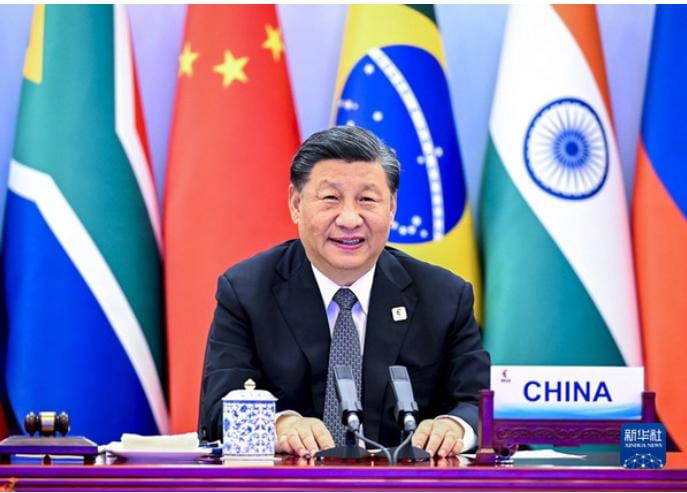
Chinese President Xi Jinping will attend the 18th BRICS Summit in New Delhi, India, from September 12 to 13, 2026, at the invitation of Indian Prime Minister Narendra Modi, the Chinese Foreign Ministry announced on Thursday.
The Foreign Ministry said the summit will focus on charting a new course for the high-quality development of greater BRICS cooperation, pooling the collective strength of the Global South and providing stability amid a world undergoing profound changes.
BRICS has grown over the past two decades into a major platform for cooperation among emerging markets and developing countries. China described itself as a staunch supporter of the group and said it has upheld the BRICS Spirit of openness, inclusiveness and win-win cooperation.
Xi first attended a BRICS Summit in March 2013 in Durban, South Africa, his first international summit as Chinese president. There he called for integrated markets, multi-tiered financial cooperation, and greater cultural exchanges among the five founding members.
As BRICS chair in 2017, Xi proposed the “BRICS Plus” model at the Xiamen Summit, urging the inclusion of more emerging markets and developing countries.
At the 16th Summit in Kazan, Russia, in October 2024 the first in-person summit after BRICS expansion Xi proposed building a BRICS committed to peace, innovation, green development, justice and people-to-people exchanges.
BRICS has now expanded to 11 member countries and 10 partner countries, including Nigeria, which became a partner country last year. The bloc accounts for nearly half of the world’s population, around 30% of the global economy, and one-fifth of global trade.
The New Development Bank , championed by Xi, has approved 139 projects worth about $43 billion by the end of 2025, focused on green energy, transport and clean water in Global South countries.
China has also established a BRICS Partnership on New Industrial Revolution innovation center in Xiamen, which has facilitated over 100 cooperation projects worth 62 billion yuan ($9.24 billion).
At the 2024 Kazan Summit, Xi called for BRICS to become “a vanguard for advancing global governance reform.” In September 2025, he proposed the Global Governance Initiative (GGI) at the SCO Plus Meeting in Tianjin, saying it aims to promote a more just and equitable global governance system.
The Rio de Janeiro Declaration from the 17th Summit last year backed reforms to increase the shares of emerging economies in the IMF and World Bank.
Analysts say BRICS has shifted the global conversation. Prof. Ronney Ncwadi of Nelson Mandela University noted: “BRICS has demonstrated that emerging and developing economies are no longer just recipients of global rules, but are increasingly participating in shaping those rules.”
The New Delhi Summit is expected to further advance cooperation in AI, digital economy, green industries, deep-sea resources and digital education.