


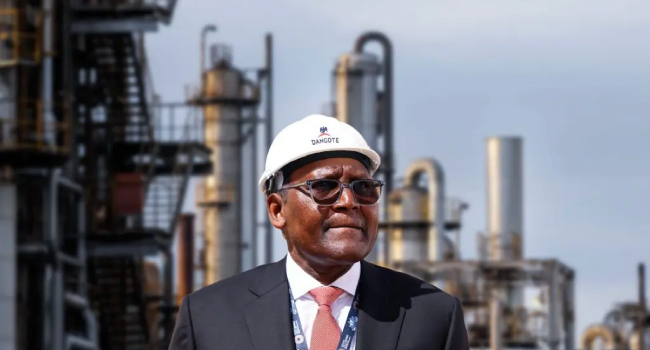
Billionaire industrialist Aliko Dangote has said he is targeting a major shift in the way Africa’s mineral resources are extracted and exported, arguing that more of the continent’s raw materials should be processed locally before being shipped abroad.
Dangote made the remarks in comments reported on October 6, 2026, as he renewed his advocacy for greater value addition within Africa’s natural-resource sector.
“If we are given the chance, we’re going to disrupt the sector where people normally come and collect our mineral resources, take it out without processing it here. That is our target,” Dangote said, according to a report published by Posh Reporters.
The statement reflects a position Dangote has expressed previously: that African countries lose substantial economic opportunities when they export raw materials and subsequently import finished products made from those same resources.
In an April 2026 interview published by THISDAY, Dangote said Nigeria had significant critical minerals but faced infrastructure constraints that made mineral exports difficult. He also said the longer-term objective should be to process minerals domestically before exporting them.
The billionaire’s latest comments therefore appear to form part of a broader industrialisation strategy rather than a standalone announcement of a new mining project.
Dangote has increasingly positioned local processing and industrial capacity as central to Africa’s economic development. In September, while discussing his expansion into East Africa, he argued that Africa needed to move away from exporting raw materials and instead develop industries capable of turning those resources into finished products.
The approach is also consistent with his business expansion across the continent. Dangote Cement, for instance, operates integrated production facilities in several African countries, while the Dangote Group has expanded investments in fertiliser, refining, energy and other industrial sectors.
The company’s wider industrial strategy has included building processing capacity around resources that would otherwise be exported or processed elsewhere. The Dangote Petroleum Refinery in Lagos, which now has a crude-processing capacity of 700,000 barrels per day, is one of the most prominent examples of the group’s effort to increase domestic processing capacity.
Dangote’s position comes as African governments and institutions increasingly focus on retaining more value from the continent’s mineral wealth. The Economic Community of West African States has also called for greater support for local industries and discouraged excessive exportation of raw materials, while promoting value addition to Africa’s natural and mineral resources.
Nigeria, in particular, has been seeking to develop its solid-minerals sector as part of efforts to diversify the economy beyond oil. The Federal Government has increasingly promoted mineral processing, investment and value-chain development as ways of creating employment, strengthening manufacturing and increasing the economic returns from the country’s mineral deposits.
Minister of Solid Minerals Development Dele Alake said in July that African countries needed to process more of their mineral resources locally to create jobs, strengthen industries and retain greater economic value on the continent.
The challenge, however, extends beyond the availability of mineral deposits. Local processing requires reliable electricity, transport infrastructure, ports, financing, technology, skilled manpower and a regulatory environment capable of supporting long-term investment.
Dangote himself highlighted infrastructure constraints in his April interview, noting that congestion at Nigeria’s major ports had created difficulties for the export of critical minerals. He said investment in infrastructure and power would be necessary to support wider industrial activity.
His latest statement does not, by itself, announce a specific new mining or mineral-processing facility, nor does it provide details of a particular investment, timeline or mineral targeted by the proposed “disruption”. Rather, the remarks set out his stated ambition to participate in changing how Africa’s mineral resources are developed and processed.
The significance of that ambition lies in the potential shift from an extraction-led model to one in which more of the economic activity associated with mining takes place within Africa — including refining, manufacturing, logistics and other stages of the value chain.
For Nigeria, the debate is particularly important as the country attempts to attract investment into its solid-minerals sector while ensuring that the exploitation of its mineral wealth translates into jobs, industrial capacity, government revenue and broader economic development.
Dangote’s comments add the voice of one of Africa’s largest private-sector investors to the growing argument that the continent should capture more value from the resources extracted from its soil rather than relying primarily on the export of unprocessed commodities.
TheDailyNewsHub has also previously reported on Dangote’s wider African industrial expansion, including his prediction that Africa could become largely self-sufficient in refined fuel by 2030, reflecting the same emphasis on developing processing capacity within the continent. Dangote Predicts Africa Will Be Mostly Self-Sufficient in Fuel by 2030
By TheDailyNewsHub News Desk