


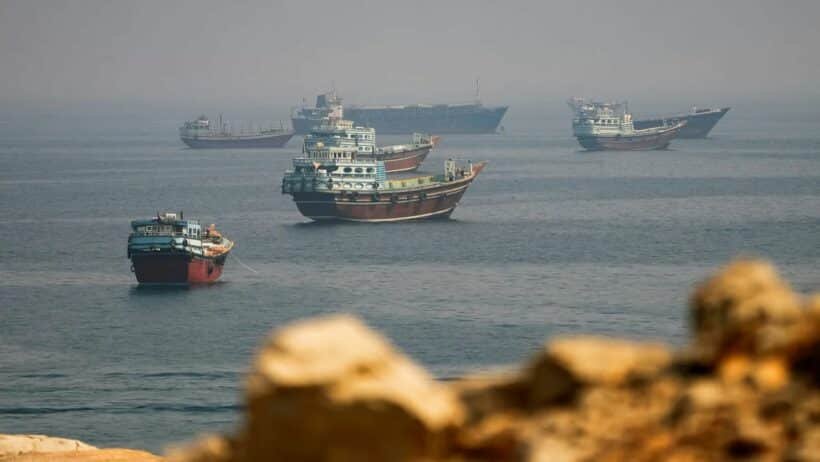
Two tankers have been attacked in the Strait of Hormuz, raising fresh concerns about maritime security and global energy supplies as Iran confirmed discussions with a Qatari delegation seeking to ease tensions between Tehran and Washington.
The incidents were reported on Saturday, November 21, by the United Kingdom Maritime Trade Operations (UKMTO), a British maritime security monitoring agency.
According to UKMTO, a tanker travelling outbound through the strategic waterway was struck on its stern by an unidentified projectile. A second report indicated that another tanker had been hit in its engine room.
No casualties were reported in the incidents, although the extent of the damage and possible environmental consequences remained unclear.
The incidents occurred near Oman’s Khasab, on the Musandam Peninsula, close to the entrance of the Strait of Hormuz. It was not immediately clear whether the two reports involved separate vessels.
The attacks came as Iran continued its confrontation with the United States over control of the strategic shipping route, which is a major passage for international oil and gas shipments.
The Iranian military separately announced that a tanker had caught fire after striking a naval mine in the strait.
In a statement carried by Iranian state television, the country’s naval forces described the vessel as an oil tanker that had entered a restricted maritime zone without authorisation.
Iranian authorities alleged that the tanker had switched off its identification and navigation systems despite warnings and maritime transit regulations.
However, it was not immediately established whether the vessel described by Iran was connected to either of the two incidents reported by UKMTO.
The latest attacks occurred against the backdrop of stalled negotiations between Iran and the United States, whose conflict began following US-Israeli strikes against Iran in February 2026.
The Strait of Hormuz has since become a central point of confrontation, with Tehran seeking to restrict maritime movements while Washington maintains measures aimed at preventing the disruption of international shipping.
The United States military has been escorting vessels through the waterway and maintaining a counter-blockade of Iranian ports.
Before the conflict, the Strait of Hormuz carried approximately one-fifth of global oil supplies, making it one of the world’s most important energy transportation routes.
The disruption has increased uncertainty for oil exporters, shipping companies and energy markets, with prolonged restrictions threatening supplies and raising transportation costs.
Amid the tensions, Iran confirmed that a Qatari delegation had visited Tehran on Friday evening for discussions with Iranian officials.
Deputy Foreign Minister Kazem Gharibabadi said the delegation held approximately two hours of talks with Iranian representatives, although he did not disclose specific details of the discussions.
Qatar has been involved in diplomatic efforts aimed at reducing tensions between Iran and the United States and creating conditions for renewed negotiations.
Iranian Foreign Minister Abbas Araghchi said diplomatic efforts in the region should be allowed to continue, but insisted that the United States must address Tehran’s demands.
He said the discussion about reopening the Strait of Hormuz could not progress while Iran’s conditions remained unmet.
Among the demands previously outlined by Tehran are an end to the war across all fronts, the unfreezing of Iranian assets, the lifting of oil sanctions and the termination of the American counter-blockade of Iranian ports.
Araghchi also maintained that Iran would not allow its stockpiles of enriched uranium to be removed from the country, describing the issue as one of Tehran’s firm negotiating positions.
Despite the renewed diplomatic engagement, there was no indication that formal negotiations between Washington and Tehran had resumed.
Iranian officials also criticised the American economic blockade, with Gharibabadi describing it as an act of war and warning that Tehran would take measures to lift it.
The diplomatic developments came as Iran reported shooting down a United States drone over Qeshm Island in the Strait of Hormuz region. The claim was reported by Iranian state television, while a US military official had earlier confirmed American strikes on an Iranian missile site on the island.
The confrontation has also created additional pressure on Iran’s domestic energy sector. President Masoud Pezeshkian said attacks on the country’s energy infrastructure had worsened supply challenges ahead of winter.
Mohammad Allahdad, head of Iran’s national electricity company, announced that rolling electricity restrictions would begin on Sunday because of fuel supply conditions.
The latest tanker incidents have renewed concerns about the security of commercial shipping in the Gulf and the possibility that further attacks could deepen disruptions to international energy markets.
TheDailyNewsHub has previously reported on rising oil prices as Iran tightened its grip on the Strait of Hormuz, highlighting the impact of the conflict on energy supplies and global markets.
For now, the Qatari diplomatic engagement offers a channel for communication between the parties, but the continuing maritime incidents and disagreements over the blockade suggest that a resolution remains uncertain.
The security of the Strait of Hormuz will remain a major concern for oil-producing countries, shipping operators and governments that depend on the uninterrupted movement of energy supplies through the region.