


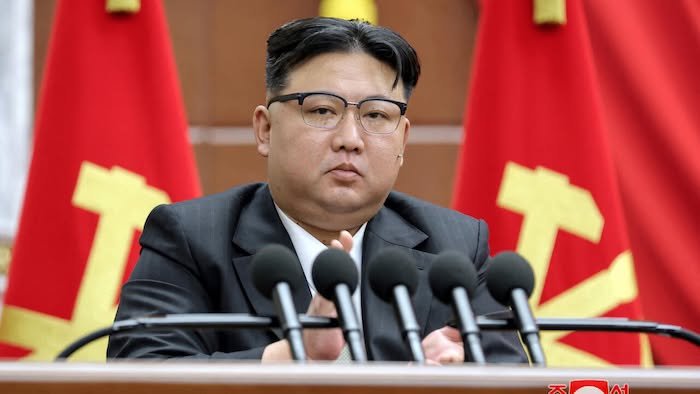
North Korean leader Kim Jong Un has called for his country to achieve what he described as “absolute superiority” in drone technology, while directing scientists to prioritise artificial intelligence (AI) in the development of unmanned military systems.
Kim made the remarks on Thursday, October 29, during an exhibition on unmanned aviation technology and a weapons demonstration in North Korea. The event, reported by the country’s state-run Korean Central News Agency (KCNA) on Friday, October 30, showcased the government’s growing focus on drones and other advanced weapons systems.
According to KCNA, Kim described drone superiority as essential in response to the changing nature of modern warfare. He also urged scientists to achieve breakthroughs in unmanned aviation and defence AI, saying the technologies should become priorities in strengthening the country’s military capabilities.
The exhibition featured different types of unmanned aerial vehicles, including tactical suicide-attack drones and multipurpose aircraft. North Korean state media also displayed images of what appeared to be a stealth flying-wing drone, although independent verification of its capabilities was not available.
A weapons demonstration followed the exhibition, featuring tactical suicide drones, tactical cruise missiles, multipurpose drones and a 600-millimetre multiple rocket launcher system known as the Sniper. KCNA claimed that missiles launched from drones and cruise missiles struck an island target with 100 per cent accuracy. The claim has not been independently verified.
The demonstration coincided with North Korea’s launch of approximately 10 short-range ballistic missiles from the Wonsan area towards the East Sea, also known as the Sea of Japan, on Thursday. South Korea’s Joint Chiefs of Staff said the projectiles travelled approximately 250 kilometres. The launches marked North Korea’s 17th ballistic missile launch of 2026, according to South Korean military assessments reported by Yonhap News Agency.
Kim’s renewed emphasis on unmanned weapons reflects a broader effort to modernise North Korea’s armed forces as drones and AI increasingly influence military operations around the world. Conflicts in Ukraine and the Middle East have demonstrated how relatively inexpensive unmanned aircraft can be deployed for surveillance, reconnaissance and attacks against military targets.
North Korea may also be drawing lessons from its military cooperation with Russia. South Korean intelligence has reported that Pyongyang sent more than 16,000 personnel to support Moscow’s war against Ukraine since October 2024. Their reported exposure to battlefield operations could provide North Korean forces with experience in drone warfare, electronic warfare and coordinated military operations.
Kim has previously called for an expansion of the country’s drone capabilities. North Korean state media reported in November 2024 that he had ordered mass production of suicide-attack drones. He subsequently oversaw tests involving AI-equipped drones in March 2025 and identified artificial intelligence as a priority in weapons modernisation later that year.
The latest demonstration comes amid heightened tensions between North and South Korea. Seoul has pledged to respond firmly to what it considers violations of the military border, while Pyongyang has criticised joint South Korea-US air defence exercises, accusing the allies of increasing tensions on the Korean Peninsula.
The dispute has also been aggravated by a landmine explosion in the Demilitarised Zone that seriously wounded South Korean soldiers. Seoul blamed the incident on a North Korean mine, while Pyongyang has denied responsibility. The United Nations Command has also said that a North Korean mine crossing the border violated the armistice agreement.
North Korea’s Defence Ministry separately warned that it had no limit to its options for maintaining a strong deterrent against what it described as military threats from the United States and its allies. The statement followed the commencement of the joint South Korea-US Freedom Flag air defence exercises, which are scheduled to continue until November 6.
Security analysts say North Korea’s growing interest in drones and military AI could alter the security calculations on the Korean Peninsula, particularly if the country develops the capacity to deploy large numbers of relatively inexpensive unmanned weapons. However, the actual operational capabilities of the systems displayed at the exhibition remain difficult to establish independently.
Kim’s latest directive signals that drone technology and artificial intelligence will remain central to North Korea’s military modernisation programme as regional tensions continue and the country seeks to strengthen its conventional weapons capabilities alongside its nuclear arsenal.