


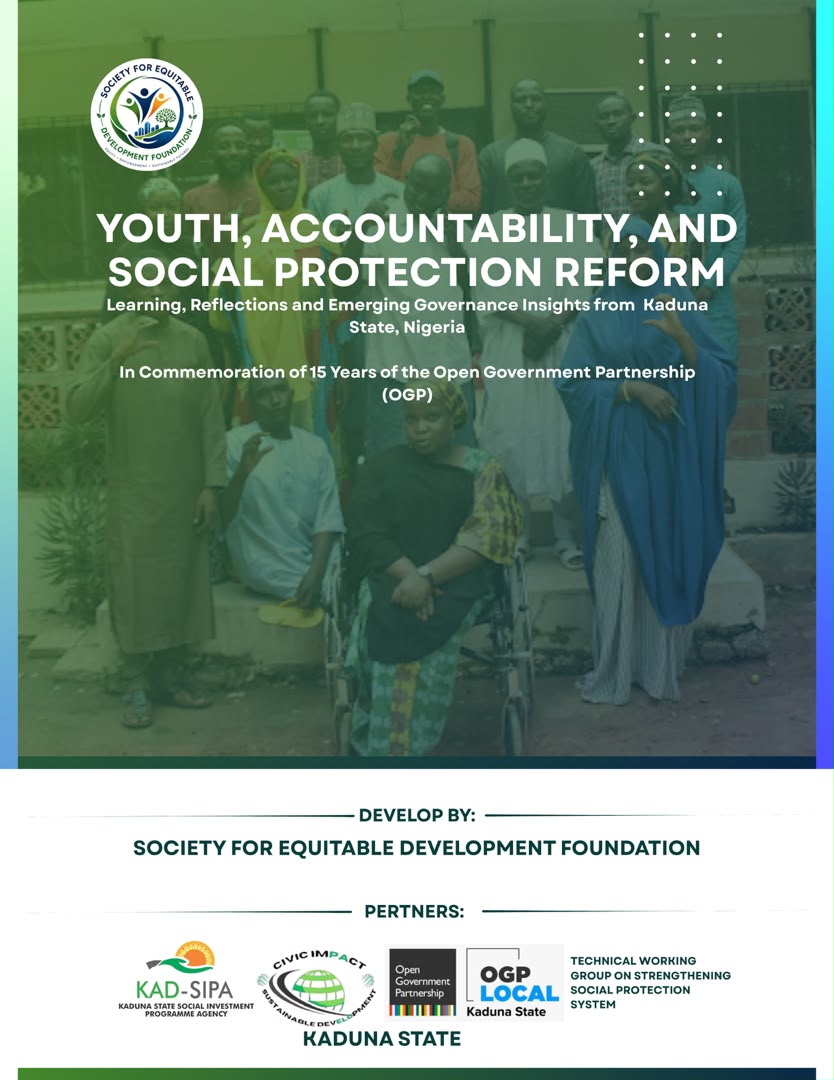
From: Femi Mustapha in Kaduna
As the Open Government Partnership marks 15 years of promoting transparency, accountability, and inclusion, Kaduna State has demonstrated how youth participation is evolving from token consultations to structured co-creation in social protection governance.
This was highlighted in a report released by the Society for Equitable Development Foundation (SEDF, Civil Society Co-Chair of the Strengthening Social Protection Systems Technical Working Group (SPTWG, as part of the Kaduna State OGP State Action Plan 3, in collaboration with the Kaduna Social Investment Program Agency, KADSIPA, and the Civic Impact for Sustainable Development Foundation, CISDF.
The report, titled “YOUTH, ACCOUNTABILITY, AND SOCIAL PROTECTION REFORM: Learning, Reflections and Emerging Governance Insights from Kaduna State, Nigeria,”, shares lessons from a Youth Media Roundtable held on Tuesday, May 19, 2026, to mark #OPENGOV WEEK2026.
The roundtable was broadcast live on Radio Maria Kaduna 90.1 FM and streamed worldwide. It brought together government officials, youth leaders, civil society members, development partners, media practitioners, and persons with disabilities to reflect on reforms and consider pathways to citizen-focused governance.
- Setting the context, the report noted that Kaduna, where over 84 percent of its population is under age 40 according to the Kaduna State Demographic and Health Survey, faces a multidimensional poverty rate above 70 percent, leaving 8.04 million citizens in ongoing deprivations.
Against this backdrop, the state has based reforms on the OGP framework to break down closed-door governance and promote transparent, coordinated, and citizen-centered policy cycles.
A key theme was dialogue and co-creation. Participants noted that when platforms are designed for structured engagement, they become spaces for collective problem-solving and direct influence on policy.
Youth advocate Usman Haruna summarized this during the dialogue, stating that “Dialogue is an institutional mechanism that produces accountability and reform. Participation should go beyond social media commentary to active involvement in town hall meetings, policy dialogues, community engagement, budget monitoring, and oversight of government projects.”
The report cited a 2024 case where the SPTWG, with technical support from Society4Equidev and CISF, brought together young people aged 25–29 to review the Kaduna State Social Protection Policy 2020–2024.
This engagement identified gaps, including limited use of technology for poverty reduction, the absence of climate mainstreaming, and a lack of youth-disaggregated data, which were later incorporated into the revised policy.
Building on that, youth groups mobilized stakeholders for equity financing for children and the integration of social protection safety nets into state climate policy, supported by Save the Children International and the Kaduna State Ministry of Environment.
The momentum has led to youth leadership within the OGP structure. A young leader now serves as the youngest co-chair on the Steering Committee for SAP 3, directly contributing to setting the agenda and coordinating reforms.
Another key theme was the shift from inclusion to creating lasting institutional change. During the development of SAP 3, youth-led recommendations increased substantially, indicating a move toward recognizing young people as legitimate governance actors rather than merely recipients.
Regarding systemic innovation, the report highlighted the deployment of Kaduna State Management Information System, KADSPMIS, which compiles data from social protection programs across MDAs into a single database.
The Ultra Poor Graduation Program (UGP), aimed at youth and women, complements this and offers skills, livelihoods, and pathways out of poverty beyond short-term cash support.
KADSIPA has pledged to incorporate UGP data into KADSPMIS to improve targeting and reduce political exclusion, and to establish a dedicated Youth Desk for ongoing youth engagement.
The Executive Secretary of KADSIPA was quoted in the report: “Together, we are building systems that will outlast us, structures that will protect generations yet unborn, and opportunities that will ensure no one is left behind. Social investment is not just a program—it is a legacy of care, compassion, and shared progress for Kaduna State.”
On climate-responsive governance, Kaduna co-developed the pioneering Community Engagement Framework for Climate-Related Shock-Responsive Social Protection and incorporated climate reporting into the Kaduna Local Government Accountability Mechanism, KAD-LGAM.
Trained citizen champions across all 23 LGAs now facilitate real-time climate shock reporting, while KAD-LGAM has created seats for young climate advocates aged 18 to 29 in its technical working groups.
Climate-responsive metrics have also been integrated into the updated State Social Protection Policy and State Youth Development Policy, reflecting an understanding that resilience, human capital, and poverty reduction are interconnected.
The report also highlighted disability inclusion through the story of Aaron Samaila Ayubal, President of the Association of Students with Disabilities, ASWD, Kaduna State University, KASU.
Aaron leveraged the OGP platform to advocate for disability-disaggregated data and accessibility, and now serves as Co-Lead for Gender and Social Inclusion under the Youth Advocacy Coalition on Demographic Dividend, YAC-DD.
Principles from his advocacy have been translated into operational guidelines under the Kaduna State Ministry of Youth Development through the Youth Engagement Power Plan, ensuring accessibility standards are embedded in governance.
Looking ahead, stakeholders identified the need for governance continuity through processes, personnel, networks, and data to protect reforms from political and administrative transitions.
To sustain this, the roundtable proposed establishing a Community of Practice as a platform for peer learning, mentorship, and skill building in budget analysis and public finance tracking.
The report outlined priority actions for Kaduna: operationalize the KADSIPA Youth Desk, institutionalize disability-inclusive oversight, deploy a gender-responsive youth advocacy toolkit, and establish a Social Protection Community of Practice.
In her acknowledgment, Sumayya Abdullahi Hussaini*, Founder/Lead of SEDF, expressed appreciation to the Kaduna State Government, KADSIPA, CISDF, the SPTWG, and all partners for shaping the state’s journey toward transparent and citizen-centered governance.
The report concludes that Kaduna’s experience offers a model for the global OGP community, demonstrating that lasting social protection reform depends not only on investment but also on strong institutions, co-creation, and accountable partnerships between government and citizens.