


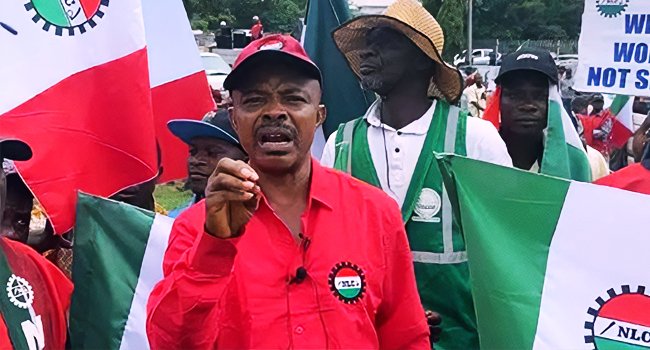
President of the Nigeria Labour Congress (NLC), Joe Ajaero, has criticised the Trade Union Congress (TUC) for rejecting the Federal Government’s ₦70,000 monthly transport intervention for workers, arguing that the union cannot oppose an agreement it did not negotiate.
Ajaero made the remarks on Thursday, October 29, during an interview on Channels Television’s The Morning Brief, following the TUC’s rejection of the six-month transport allowance and its demand for an immediate salary increase.
“The agreement was not signed by TUC; you don’t kick against something you did not negotiate or never asked for,” Ajaero said, adding that the NLC had negotiated independently with the Federal Government.
He said the TUC had distanced itself from the negotiation process and that the NLC had publicly clarified it was acting alone. According to Ajaero, the TUC could have pursued a separate demand for a higher allowance rather than rejecting the arrangement secured by the NLC.
“I would have preferred a situation whereby if NLC was asking for one naira, TUC would be asking for 10 naira, and probably the government would harmonise it,” he said.
The Federal Government approved the ₦70,000 monthly transport intervention for public service workers for six months, beginning in November 2026, following a conciliation meeting with the NLC on October 27. The agreement also covers outstanding peculiar allowance arrears and payments owed to health workers.
The TUC, however, rejected the intervention on Wednesday, arguing that temporary financial support would not provide sustainable relief for workers facing rising living costs. The congress called for an immediate salary increase and proposed raising the pay of the Federal Government’s lowest-paid worker from ₦70,000 to ₦300,000, with corresponding adjustments across other salary levels. Read more in TheDailyNewsHub’s report on the TUC’s rejection of the ₦70,000 transport allowance.
Ajaero also challenged the suggestion that the government should simply raise salaries without following the relevant procedures. He said wage increases required a formal process and pointed to disagreements between the two labour centres over when negotiations for a new national minimum wage should begin.
The NLC president said his organisation believed the minimum-wage negotiation process should commence earlier than the date proposed by the TUC. He maintained that the transport intervention was an outcome of negotiations and pressure exerted by the NLC over workers’ welfare.
The disagreement highlights differences between the two major labour organisations over how best to address the cost-of-living pressures affecting Nigerian workers. While the NLC has defended the transport allowance as a negotiated gain, the TUC insists that a lasting improvement in workers’ welfare requires higher salaries and the implementation of outstanding agreements.
The debate is likely to continue as labour leaders engage the government over wages, transport costs and unresolved commitments to public-sector workers.