


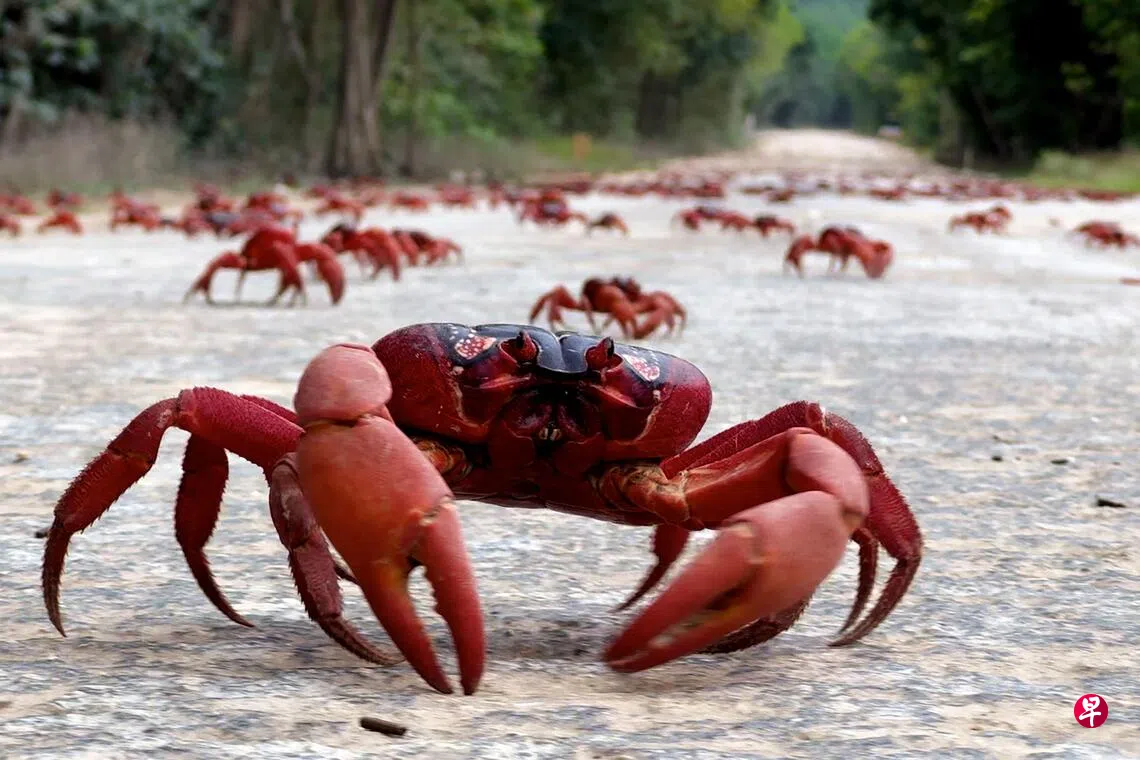
More than 100 million red crabs have begun their annual migration from the forests of Australia’s Christmas Island to the ocean, creating a spectacular display as the crustaceans move across roads, bridges and coastal areas to breed.
The migration, which began following the arrival of wet-season rainfall, is one of the island’s most remarkable natural events, drawing attention from wildlife enthusiasts and researchers around the world.
According to Parks Australia, the mass movement involves millions of red crabs emerging from their forest habitats and travelling towards the coast, where they mate and release their eggs into the sea.
Christmas Island National Park Manager Chris Chartres estimated that between 100 million and 150 million crabs could take part in this year’s migration.
The journey is influenced by rainfall and the lunar cycle. The first rains of the wet season trigger the movement, while the crabs time their arrival at the coast to coincide with suitable tidal and moon conditions.
Parks Australia explained that the crabs aim to release their eggs before dawn during a receding high tide in the last quarter of the moon.
Male crabs generally lead the migration, with females joining them along the way. After reaching the coast, they prepare for mating and spawning.
The migration has a significant impact on daily life on the island, which covers approximately 135 square kilometres in the Indian Ocean, about 350 kilometres south of Indonesia and more than 1,000 kilometres from mainland Australia.
As millions of crabs cross roads and populated areas, authorities temporarily close some routes and introduce traffic management measures to reduce the number of animals killed by vehicles.
Rangers and residents also work together to move crabs away from vehicle paths using gentle raking techniques. Specially constructed crab bridges, underpasses and roadside barriers help the animals cross busy roads more safely.
Speaking to ABC News, Chartres described the migration as a major disruption to normal activities but said residents had adapted to the annual event.
The island’s residents have developed ways of navigating the roads during the migration, including travelling in convoys and working with others to clear crabs from vehicle paths.
Researchers study how crabs navigate
The migration has also attracted scientific interest, particularly concerning how the crabs find their way from the forest to the coast.
Researchers from Lund University in Sweden, including professors Marie Dacke and Eric Warrant, are studying the animals’ navigation abilities.
The scientists are investigating whether the crabs rely on environmental signals such as the sun, the Earth’s magnetic field or polarised light to determine their direction.
Researchers are also interested in whether younger crabs can learn migration routes by following older members of the population.
Despite the spectacular nature of the journey, scientists say several aspects of the crabs’ navigation and collective behaviour remain unclear.
Conservation efforts help population recover
The annual migration is also important to the ecological health of Christmas Island. Red crabs are considered a keystone species because they help recycle nutrients, consume leaf litter and maintain the structure of the island’s tropical rainforest.
However, the population has faced threats from invasive yellow crazy ants, which have displaced large numbers of crabs by occupying their burrows and attacking them.
Parks Australia said ongoing conservation efforts, particularly programmes to control the invasive ants, have helped the red crab population recover from an estimated 50 million to its current level.
The park authority described the recovery as an encouraging sign for the island’s ecosystem, noting that the health of the red crab population has wider implications for the rainforest.
After spawning, the eggs hatch when they come into contact with seawater. The larvae are carried into the ocean, where they develop through several stages before young crabs eventually return to the island.
Only a small proportion of the larvae survive the journey, with many becoming food for marine animals, including fish, manta rays and whale sharks.
Parks Australia has also introduced livestreams for the 2026 migration, allowing people outside the island to observe the natural spectacle. Recordings of the broadcasts are available through the Christmas Island National Park migration page.
The annual movement remains one of Australia’s most distinctive wildlife events, highlighting the relationship between seasonal weather, animal behaviour and conservation efforts.
SEO Details
- Focus keyphrase: Christmas Island red crab migration
- SEO title: Over 100 Million Red Crabs Begin Annual Migration on Christmas Island
- Meta description: More than 100 million red crabs have begun their annual journey to the sea on Australia’s Christmas Island, as rainfall and lunar cycles guide the migration.
- URL slug:
christmas-island-red-crab-migration-2026 - Category: Environment
- Tags: Christmas Island, Red Crabs, Australia, Wildlife Migration, Parks Australia, Conservation, Biodiversity, Climate and Environment