


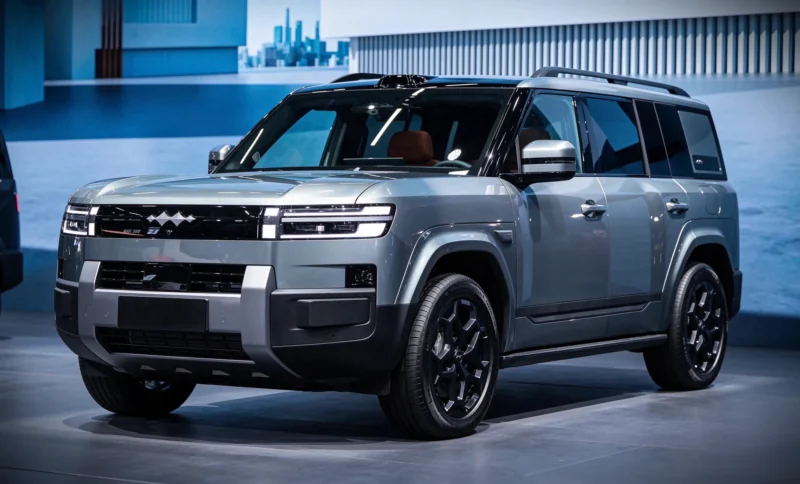
Jaguar Land Rover (JLR) has vowed to protect its intellectual property after a Dutch court temporarily barred Chinese automaker BYD from selling its Ti7 sports utility vehicle (SUV) across the European Union over similarities with the Land Rover Defender.
The British luxury carmaker said it would continue to defend its designs and take legal action where necessary following the ruling by the District Court of The Hague.
“JLR continues to invest in creativity and innovation. We protect our intellectual property and take legal action when necessary,” a Jaguar Land Rover spokesperson said.
The court ruled on Friday, November 20, that BYD’s Ti7 infringed JLR’s registered European Union design rights for the Defender L663, citing similarities in several distinctive elements of the vehicles.
These include the curved shoulders of the bodywork, rounded corners, wheel arches and the overall silhouette of the vehicles.
The injunction temporarily prohibits BYD and its relevant subsidiaries from importing, manufacturing, stocking or selling the Ti7 within the 27-member European Union while the legal dispute continues.
The ruling also affects plans to manufacture the vehicle at BYD’s new factory in Hungary, although the court’s order does not prevent its planned launch in the United Kingdom.
The dispute began after JLR challenged BYD’s plans to introduce the seven-seat Ti7 SUV into European markets, arguing that its design closely resembled the iconic Defender.
BYD launched the Fangchengbao Ti7 in China in 2025 and subsequently announced plans to expand its availability internationally. The vehicle is part of the company’s Fangchengbao sub-brand.
The Chinese automaker strongly rejected the court’s findings, insisting that the Ti7 was developed through its own independent design process.
“BYD strongly disagrees with today’s judgment and will appeal it. The BYD Ti7 is the result of BYD’s own independent design work and infringes none of JLR’s rights,” the company said in a statement.
The company added that it would pursue all available legal avenues to challenge the decision.
The Dutch court’s ruling is provisional and was issued in preliminary proceedings rather than a final determination of the entire dispute. JLR must pursue substantive proceedings within the period set by the court to maintain the injunction.
The court also declined to grant JLR’s request to block sales of the vehicle in the United Kingdom, ruling that it lacked jurisdiction over BYD’s British subsidiary.
Consequently, the planned UK deliveries of the Ti7 are expected to proceed from January 2027, subject to any further legal developments.
The case comes as Chinese automakers expand their presence in Europe, increasing competition with established manufacturers through a growing range of electric and hybrid vehicles.
BYD has become one of the most prominent Chinese automotive brands in the European market, while traditional manufacturers have raised concerns about competition, intellectual property protection and the speed of Chinese manufacturers’ international expansion.
For JLR, the Defender remains one of its most recognisable models and a significant part of its global vehicle portfolio.
The legal dispute could have wider implications for automotive design protection in Europe, particularly as manufacturers increasingly compete in the SUV market with vehicles that share similar styling characteristics.
The outcome of the substantive proceedings and BYD’s planned appeal will determine the next stage of the dispute between the two automotive companies.