


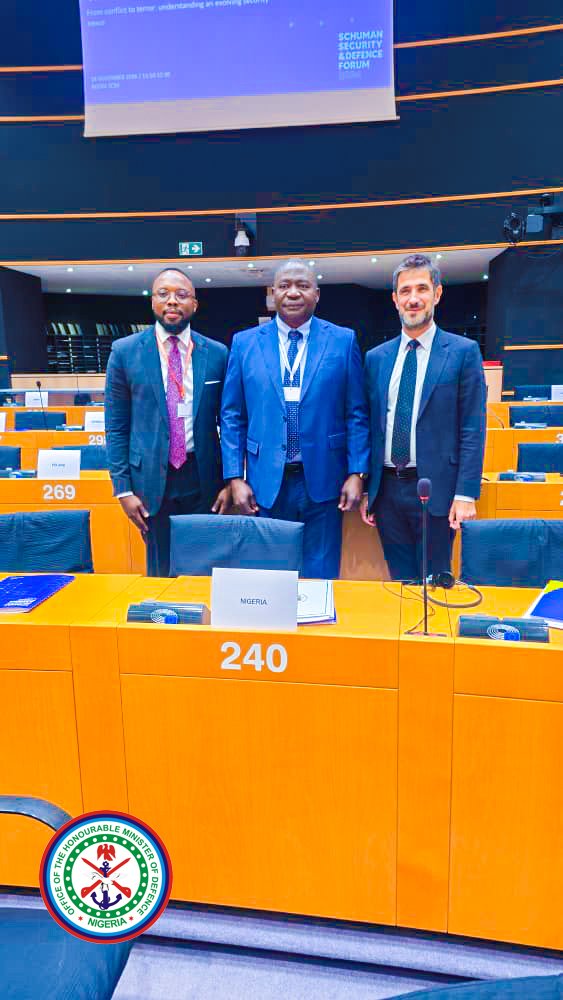
Nigeria’s outing at the 2026 Schuman Security and Defence Forum in Brussels was not just another diplomatic trip. For the Minister of Defence, General Christopher Gwabin Musa (Rtd.), it was a deliberate push to move the country from buying security to building it.
Musa, who has just returned to Abuja after the forum and follow-up engagements in Lagos and Ibadan, said the central message Nigeria took to Europe was simple: the country is ready to partner, but it wants technology transfer, local production and joint innovation not just equipment.
According to a statement by his media aide, Leah Katung-Babatunde, the Minister told European defence leaders that Nigeria’s fight against terrorism can no longer depend solely on imported hardware.
Instead, he pitched Nigeria’s growing indigenous defence ecosystem from counter-drone systems to digital forensics and satellite intelligence as an area ripe for joint development with EU partners.
The pitch, sources close to the delegation said, drew strong interest. EU counterparts reportedly agreed to explore technical cooperation in military artificial intelligence, counter-drone technologies and intelligence tools, with a focus on building capacity inside Nigeria.
Beyond technology, Musa also used the forum to sell Nigeria’s non-kinetic approach to counterterrorism the idea that guns alone will not end insurgency.
He pointed to the National Counter Terrorism Strategy (NACTEST) and institutions like the National Counter Terrorism Centre (NCTC), the Nigerian Financial Intelligence Unit (NFIU) and Operation SAFE CORRIDOR as proof that Nigeria is combining military action with deradicalisation, financial tracking and community reintegration.
International stakeholders at the forum, the statement said, commended the model, describing it as holistic and worthy of support.
On the sidelines, Musa held closed-door talks with African and European counterparts on strengthening the Multinational Joint Task Force (MNJTF) in the Lake Chad Basin, ECOWAS security frameworks and the West Africa Police Information System (WAPIS).
The aim, he said, was to ensure that regional cooperation keeps pace with the mobility of terrorist groups across borders.
Back home, the Minister said the real work starts now. The Ministry of Defence will convert the Brussels commitments into concrete operational support for troops in all theatres, while upholding civilian protection, due process and international humanitarian law.
For Musa, the Brussels trip was therefore less about attendance and more about repositioning positioning Nigeria not just as a consumer of global security assistance, but as a partner with a strategy, a framework and a growing capacity to produce its own solutions.