


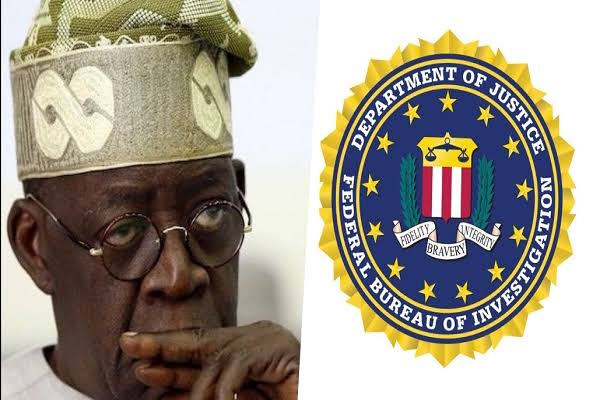
The United States Federal Bureau of Investigation (FBI) has warned that releasing certain records linked to investigations involving Nigerian President Bola Ahmed Tinubu could expose informants, agents and other individuals to violent retaliation, including possible assassination.
The warning was contained in a court filing submitted on Friday, August 28, 2026, in an ongoing Freedom of Information Act (FOIA) case before Judge Beryl Howell of the U.S. District Court for the District of Columbia.
The case stems from FOIA requests filed by American transparency activist Aaron Greenspan, who is seeking records relating to investigations involving Tinubu dating back to the 1980s and 1990s. The requests cover records held by agencies including the FBI, Drug Enforcement Administration (DEA), Central Intelligence Agency (CIA), Internal Revenue Service and U.S. immigration authorities.
FBI cites safety concerns
In its latest filing, the FBI invoked FOIA Exemption 7(F), which allows agencies to withhold law-enforcement information where disclosure could reasonably be expected to endanger an individual’s life or physical safety.
The bureau argued that releasing names and other identifying information contained in the investigative records could expose people who participated in or assisted investigations to retaliation.
According to the FBI, some individuals mentioned in the files could face threats from people connected to the criminal activities under investigation.
The agency also said that individuals who provided information or participated in the investigation as law-enforcement personnel could potentially be violently targeted if their identities were disclosed.
The FBI has therefore asked the court to allow portions of its justification to remain confidential, with some material submitted privately for the judge’s review.
Records remain under court review
The latest development follows a series of court proceedings over the release of the records.
Judge Howell previously ordered the FBI and DEA to search for and process non-exempt records responsive to Greenspan’s requests after ruling that the agencies’ earlier refusal to confirm or deny whether they possessed records concerning Tinubu was improper.
The FBI subsequently produced records while maintaining that some information should remain redacted under various FOIA exemptions.
The agency has also submitted disputed material to the court for private review, rather than making all of the records publicly available. Reports indicate that records connected to the case were delivered to Judge Howell under seal on August 28.
Tinubu opposes further disclosure
Tinubu has intervened in the case and is seeking to prevent the release of additional records, arguing that FOIA protections apply to private information contained in government investigative files.
His legal team has asked the court to uphold existing redactions and withholdings, arguing that the records concern private individuals and that disclosure would constitute an unwarranted invasion of privacy.
The dispute centres on historical U.S. investigations and records concerning Tinubu. It includes a 1993 civil forfeiture case in which about $460,000 associated with him was forfeited to the U.S. government. Tinubu has denied wrongdoing, and the ongoing FOIA proceedings do not establish that he was criminally convicted of drug trafficking.
The latest FBI filing therefore represents the bureau’s argument for keeping certain information confidential on safety and law-enforcement grounds, rather than a judicial finding that anyone connected to the case is in imminent danger.
The court is expected to determine which portions of the requested records can legally be released and which must remain protected under U.S. law.