


By Femi Mustapha
The Task Shifting Task Sharing (TSTS) investment in Kaduna State has recorded significant gains in primary healthcare delivery after a 24-month pilot implementation across 77 facilities.
In her presentation at the TSTS closeout ceremony, Gates Foundation Program Officer Hajiya Fatima Muhammad Mu’azu stated that the TSTS investment was implemented from October 2024 to September 2026 in nine local government areas and 77 PHCs across the three senatorial zones, reaching more than 400 health workers.
The closeout ceremony, themed “From Capability to Confidence: Celebrating the People, Results, and Future of TSTS in Kaduna State,” was held on Monday, October 27, 2026, at Muhammadu Buhari Hall, Galaxy Mall, Kaduna.
Hajiya Mu’azu explained that the LGAs included Makarfi, Sabon Gari, and Soba in the Northern Zone; Igabi, Kaduna North, and Kaduna South in the Central Zone; and Jema’a, Kaura, and Zangon Kataf in the Southern Zone.
She said the investment, implemented by Pathfinder International and Impact Catalysts with funding from the Gates Foundation, was designed to address workforce gaps, frontline pressure, fragmented training, and weak supervision by optimizing available human resources for health.
According to her, the model enables appropriately trained Community Health Extension Workers (CHEWs) and Junior CHEWs to deliver defined services within the approved TSTS framework.
Presenting key results and the impact of the changes over the past two years, Hajiya Mu’azu said the project focused on clinical mentorship and monitoring, evaluation, and learning, with monthly facility mentorship visits, bedside coaching, the use of standard reporting tools, and strengthened LGA M&E and HMIS officers.
She noted that, in terms of data quality, routine monthly spot checks across the 77 facilities showed improvement at the facility level, with 97 percent of M&E personnel routinely comparing facility registers with Monthly Summary Forms (MSFs). In contrast, 90.1 percent routinely compared DHIS2 with MSFs, though the last mile to DHIS2 entry still requires targeted improvement.
“On clinical competence, measured through Objective Structured Clinical Examination (OSCE), the team said Postpartum Hemorrhage (Hemorrhage), which began as the lowest-scoring service area, recorded the biggest gain from 20.9 percent to 9 percent, with average overall OSCE scores rising significantly after months of on-site coaching,” she said.
Similarly, on clinical judgment assessed through case vignettes, she said 79.2 percent of mentees scored adequate by June 2026, up from 33.8 percent in February 2026, with newborn sepsis recording the largest single gain of 17 percentage points.
Hajiya Mu’azu added that service coverage across six tracked indicators in the 77 PHCs rose significantly between Q3 2024 and Q2 2026, with Vitamin A supplementation increasing by 38.9 percentage points, Penta 3 by 24.5, ANC 4 by 12.1, Postpartum Family Planning by 10.8, Postnatal Care by 5.8, and Skilled Birth Attendance by 2.1, all at p<0.001.
She identified four key lessons Kaduna now knows about making TSTS work: mentorship converts training into competence; competence without commodities still ends in referral; data quality breaks at the last mile; and working through state structures makes the model transferable.
Other emerging lessons, she said, included improved provider confidence, better patient experience and communication, reduced waiting time, improved data practices, and better referral coordination between PHCs and secondary facilities.
As part of sustainability efforts, she outlined five priority actions for Kaduna State and its partners, including institutionalizing TSTS mentorship and cascade training within routine systems, agreeing on a financing approach, strengthening workforce retention, using evidence to scale up, and clarifying ownership and accountability.
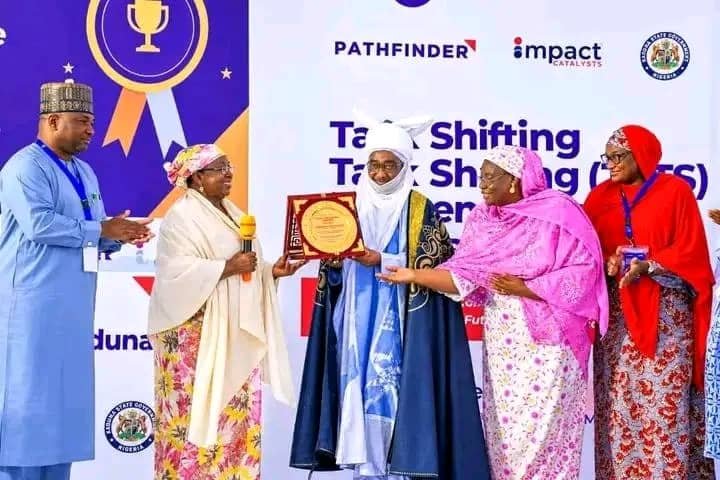
The ceremony featured impact statements from mentees and mentors, a documentary video, a debate on whether TSTS is a sustainable strategy for strengthening PHC in Nigeria, awards and recognition for stakeholders, and an official handover from Pathfinder and Impact Catalysts to the Permanent Secretary of Kaduna State.
Hajiya Mu’azu opined that sustaining TSTS means sustaining skills, mentorship, data use, and state ownership, noting that closeout is not an end but a transition point for sustaining the practices and systems that support quality PHC delivery in the state.
Keynote addresses were also delivered by the Honorable Commissioner for Health, Kaduna State, and the Gates Foundation. At the same time, reflections on the investment were presented by Dr. Ismail, Managing Partner of Impact Catalysts, alongside presentations by the TSTS team on the journey from policy to practice.