


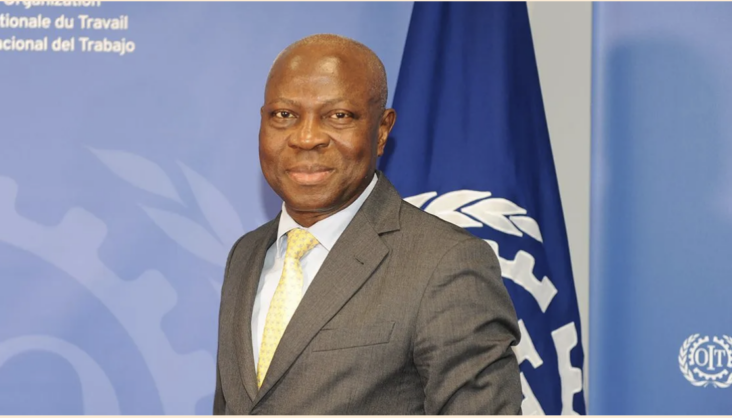
Former Togolese Prime Minister Gilbert Houngbo has been re-elected Director-General of the International Labour Organization (ILO), securing a second five-year term at the helm of the United Nations agency responsible for promoting workers’ rights and social justice.
Houngbo was re-elected on Monday, November 16, during the 358th Session of the ILO Governing Body in Geneva, Switzerland, after receiving 51 of the 56 votes cast. The remaining five members abstained.
His re-election followed the withdrawal of his only remaining challenger, Spanish Labour Minister Yolanda Díaz Pérez, shortly before the election. Díaz said she withdrew to avoid further divisions within the international trade union movement.
Another candidate, former Peruvian Foreign Minister Javier González-Olaechea Franco, had withdrawn from the contest earlier in November.
Houngbo’s second mandate will begin on October 1, 2027, and run until September 30, 2032. He first became Director-General in March 2022, taking office on October 1 of that year as the first African to lead the organisation.
Following his re-election, the 65-year-old Togolese official reaffirmed the importance of the ILO’s mission, particularly its role in promoting decent work, protecting human dignity and advancing social justice.
“More than a century after its founding, our organisation remains charged with a mission that is more relevant than ever: to promote social justice as the foundation for universal and lasting peace,” Houngbo said.
He also identified artificial intelligence as one of the most significant challenges shaping the future of work, warning that technological transformation would raise important questions about employment, skills and working conditions.
He said the ILO must remain at the forefront of efforts to ensure that technological progress serves humanity.
Challenges facing the ILO
Houngbo begins his second term at a time of significant financial and institutional pressure on the Geneva-based organisation.
The ILO has faced funding difficulties following reductions and delayed contributions from some major donors, particularly the United States, traditionally its largest financial contributor.
The financial constraints have forced the organisation to consider reforms, including reductions in staffing and adjustments to its operations.
Díaz, in announcing her withdrawal from the election, criticised the organisation’s financial management, describing its situation as the deepest financial crisis in its history.
She also questioned the direction of its leadership and expressed concern about divisions within the international labour movement.
Despite the criticism, Houngbo secured overwhelming support from the Governing Body, which brings together representatives of governments, employers and workers.
The ILO’s tripartite structure distinguishes it from other United Nations specialised agencies by giving employers’ and workers’ representatives a formal role alongside governments in its decision-making processes.
Houngbo’s background and leadership priorities
Born in Togo, Houngbo served as the country’s Prime Minister from 2008 to 2012. Before entering government, he worked with the United Nations Development Programme (UNDP), where he held several senior positions.
He joined the ILO in 2013 as Deputy Director-General before becoming President of the International Fund for Agricultural Development (IFAD) in 2017.
His first term as ILO Director-General focused on promoting decent work, strengthening social protection, improving employment opportunities and advancing dialogue between governments, employers and workers.
For his second mandate, he is expected to continue institutional reforms while addressing emerging challenges in the global labour market.
Artificial intelligence, digital transformation, changing employment patterns, workers’ rights and social protection are expected to feature prominently in the organisation’s priorities.
The African Union Commission Chairperson, Mahmoud Ali Youssouf, congratulated Houngbo on his re-election, describing it as a reflection of renewed confidence in his leadership and commitment to social justice.
The African Union also reaffirmed its commitment to working with the ILO on employment opportunities for young people and women, skills development, social protection and inclusive economic growth.
Houngbo’s re-election ensures continuity in the leadership of the world’s principal international labour organisation as it navigates financial pressures and major changes in the nature of work.