


By Femi Mustapha in Kaduna
For more than a decade, what started in the Northwest as sporadic cattle rustling and communal reprisals has mutated into one of the most lucrative criminal economies in West Africa.
In the early 2010s, attacks in Zamfara, Katsina, Kaduna, and Sokoto were largely opportunistic: armed men on motorcycles raided villages for livestock and foodstuffs, then retreated into the vast, ungoverned forests that straddle state boundaries.
Over time, that crude enterprise became professionalized, and security analysts agree that two invisible actors accelerated the transformation: the local informant who lives within the community and the gunrunner who guarantees the firepower.
Today, Nigerians are experiencing growing anxiety over the vital roles these two groups play in sustaining the multi-billion-naira kidnapping industry. This industry has turned highways, schools, and even gated estates on the outskirts of cities into hunting grounds.
While security operations frequently focus on neutralizing active kidnappers and bandits in the forests, experts and citizens warn that the crisis cannot be solved without dismantling the logistics and intelligence networks that support them.
According to Dr. Kabir Adamu, a renowned security risk analyst and managing director of Beacon Consulting, no bandit group operates by chance. He notes that every successful abduction is now preceded by precise intelligence supplied by someone who knows the victim, the terrain, and the movements of security agents.
Dr. Adamu explains that kidnapping for ransom in Nigeria has evolved into a highly calculated, corporate-style enterprise that relies heavily on local intelligence, with informants often living within target communities.
Their first and most damaging role, he says, is precision targeting. Bandit groups now routinely carry out sophisticated, door-to-door raids using specific lists, with informants providing data on who recently received money, who owns successful businesses, and the routine movements of vulnerable individuals.
Retired Assistant Inspector-General of Police AIG Wilson Inalegwu, who served in the Northwest, describes informants as the “eyes and bankers” of bandits. According to him, they tell criminal gangs who just sold land, who just returned from abroad, and how much ransom a family can realistically pay before an attack is launched.
The second role, according to security consultant and former DSS operative Barrister Chinwe Okafor, is sabotage from within. She points to high-profile arrests in recent years in Oyo and Kaduna states, which reveal that community members, and sometimes local leaders or compromised security personnel, actively supply operational intelligence and share in the ransom payouts.
Perhaps most dangerous is their third role: compromising rescue operations. AIG Inalegwu notes that informants frequently tip off criminal syndicates about police tracking or military deployments, undermining law enforcement efforts and placing victims in greater danger.
Citizens in frontline communities share this fear. A resident of Millennium City in Chikun Local Government Area of Kaduna State, Mallam Suleiman Danladi, who asked that his full identity be protected, said his community now suspects its own neighbors. He lamented that after every kidnapping, it becomes clear that someone must have disclosed that a man has money or that his children are at home.
The terrifying scale of mass abductions, ranging from travelers on federal highways to students in rural schools, is sustained by a steady supply of military-grade weaponry, without which bandits could not hold territory or confront state forces.
Dr. Ona Ekhomu, chief security strategist at the Institute for Security Studies Africa, explains that gunrunners leverage Nigeria’s porous borders and weak governance structures to traffic AK-47 rifles, pump-action shotguns, and even fabricated rocket launchers directly to bandit hideouts.
This seamless flow of illegal arms, Dr. Ekhomu warns, allows criminal syndicates to easily outgun local vigilantes and terrorize entire regions, turning parts of the North-West, Middle Belt, and South-East into dangerous security blind spots.
He notes that the arms pipeline is transnational. Weapons move from the Sahel after falling from Libyan stockpiles, through Niger, and into Nigeria, often concealed in trucks carrying grains, livestock, or household goods, making detection extremely difficult without technology.
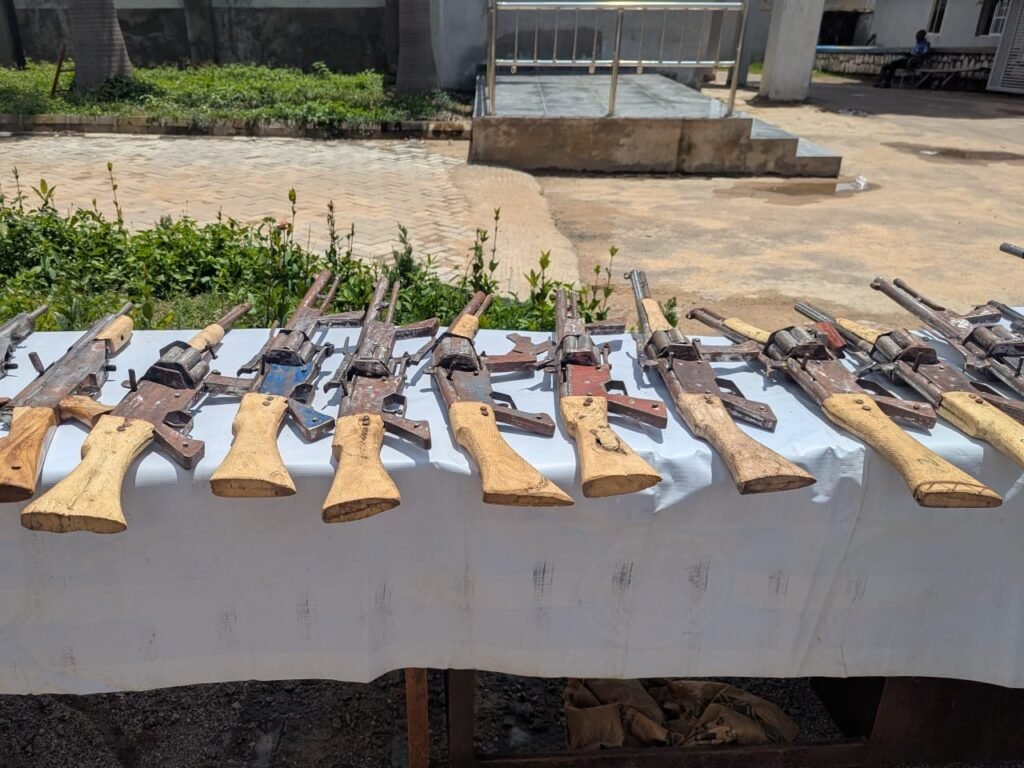
Recent crackdowns by the Nigeria Police Force, such as operations in Kaduna and Delta, have continuously netted gunrunners operating alongside kidnapping syndicates, confirming the nexus between arms trafficking and abduction, according to police sources.
The Department of State Services (DSS) and the Federal Capital Territory (FCT) Police Command have also intercepted high-profile ammunition couriers and arms suppliers. Notable operations include tracking arms shipments moving from Nasarawa and Plateau states into bandit strongholds in Katsina and Zamfara.
To prevent recovered weapons from re-entering the black market, the National Center for the Control of Small Arms and Light Weapons (NCCSALW), led by its National Coordinator, DIG Johnson Babatunde Kokumo (rtd.), has conducted large-scale public destructions, permanently removing thousands of illicit firearms, including AK-47 and FN FAL rifles, from circulation.
Yet despite these efforts, the pipeline remains resilient, largely because the economics favor it. Dr. Adamu points out that a single AK-47 that costs about $500 in the Sahel can be sold for over $2,000 in a bandit camp, creating a profit margin that funds further smuggling.
The human cost of this alliance was brought into sharp focus in Kaduna State last week, where the Police Command announced a breakthrough in Millennium City and Maraban Rido, two fast-growing suburbs of the Kaduna metropolis largely surrounded by forested areas.
In a press release dated October 12, 2026, and signed by the Police Public Relations Officer, DSP Mansir Hassan, the Command said it had intensified clearance operations, targeted raids, and patrols in collaboration with other security agencies.
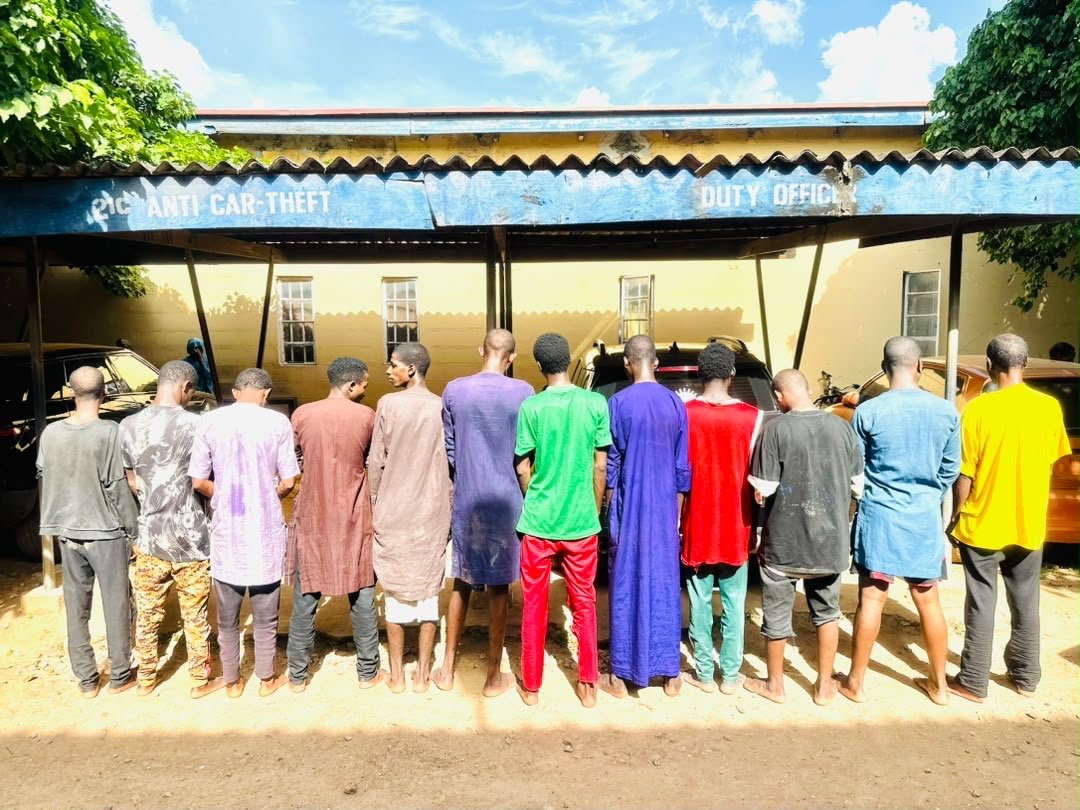
The sustained operations, according to the statement, resulted in the arrest of eight suspected kidnappers, identified as Dauda Murna, Usman Abdullahi, Abubakar Sulaiman, Saleh Abdullahi, Usman Muhammed, Mathias Moses, Makama John, and Tafarki Audu.
Four suspected informants were also arrested: Shuaibu Sabiu, Audu Makama, Simon Moses, and Amadu Mathew. AK-47 rifles were also recovered during the operations.
The Command expressed particular concern about the activities of individuals suspected of supplying kidnappers with intelligence on security movements and operations, noting that preliminary investigations indicated that two of the suspects had allegedly confessed to leaking information about police operations.
That confession, Barrister Okafor says, validates what communities have long suspected: that some informants are embedded close enough to security formations to undermine operations and endanger the lives of personnel and residents.
Following the arrests, the police said investigations are ongoing to establish the full extent of the suspects’ involvement, identify other accomplices, and bring all those connected to the criminal activities to justice.
In a bid to address the security challenges in Millennium City and its suburbs, the Kaduna State Government has released three additional armored personnel carriers (APCs) to the police command to strengthen operational capacity and enhance security.
The command has assured residents that clearance operations targeting criminal hideouts will be sustained to dismantle criminal networks, disrupt their activities, and facilitate the rescue of kidnapped victims.
On October 10, 2026, a high-powered government delegation led by the Chief of Staff to the Executive Governor, Malam Sani Kila, and other security chiefs held an engagement meeting with traditional rulers, community members, and other stakeholders from the affected areas.
During the meeting, Kila reiterated that security is a collective responsibility and urged residents, community leaders, landlords, and youth groups to report individuals suspected of aiding or abetting criminal activity promptly
The Commissioner of Police, CP Muhammad Rabiu, also ordered the immediate deployment of additional tactical personnel, operational vehicles, and other security resources to the affected areas to intensify surveillance and improve response times.
He called on members of the public to remain calm, vigilant, and cooperative with security agencies by providing credible and timely information to assist in the fight against kidnapping.
For many citizens, however, vigilance alone is not enough. Hajiya Aisha Bello, a civil society activist and executive director of the Kaduna-based Center for Community Peace, argues that informants thrive because of poverty, drug abuse, and the collapse of community trust.
She notes that young men with no livelihood are easily recruited for as little as N20,000 to monitor a target, take photographs of a house, or report when a family returns from the market.
Experts agree and propose a multilayered solution. Dr. Ekhomu says the first step is dismantling the intelligence network through community vetting, stronger oversight of traditional institutions, and protection for whistleblowers who report informants.
Second, AIG Inalegwu calls for a total disruption of the arms supply chain by tightening border control with technology such as drones and scanners, improving interagency intelligence sharing under the Office of the National Security Adviser (ONSA), and ensuring the swift prosecution of gunrunners to break the profit incentive.
Third, Barrister Okafor recommends addressing the forest economy, as many forests in the Northwest remain ungoverned and provide safe havens. She advocates for forest rangers, satellite surveillance, and deliberate resettlement programs to deny bandits sanctuary.
Finally, Dr. Adamu insists on addressing the root socio-economic drivers, including illiteracy, unemployment, and the proliferation of hard drugs that fuel recruitment into informant networks, while ensuring that rescued communities receive justice and psychosocial support.
Until the informant who points the finger and the gunrunner who provides the gun are treated as equally culpable as the bandit who pulls the trigger, analysts warn, Nigeria’s multi-billion-naira kidnapping industry will continue to thrive. Millennium City may be the latest name on a long, painful list.