


By: Femi Mustapha, Kaduna
The Kaduna State Government states it is committed to leaving no child behind in its efforts to combat illiteracy through the Reaching Out-of-School Children (ROOSC) project supported by community coalitions across all 23 local government areas.
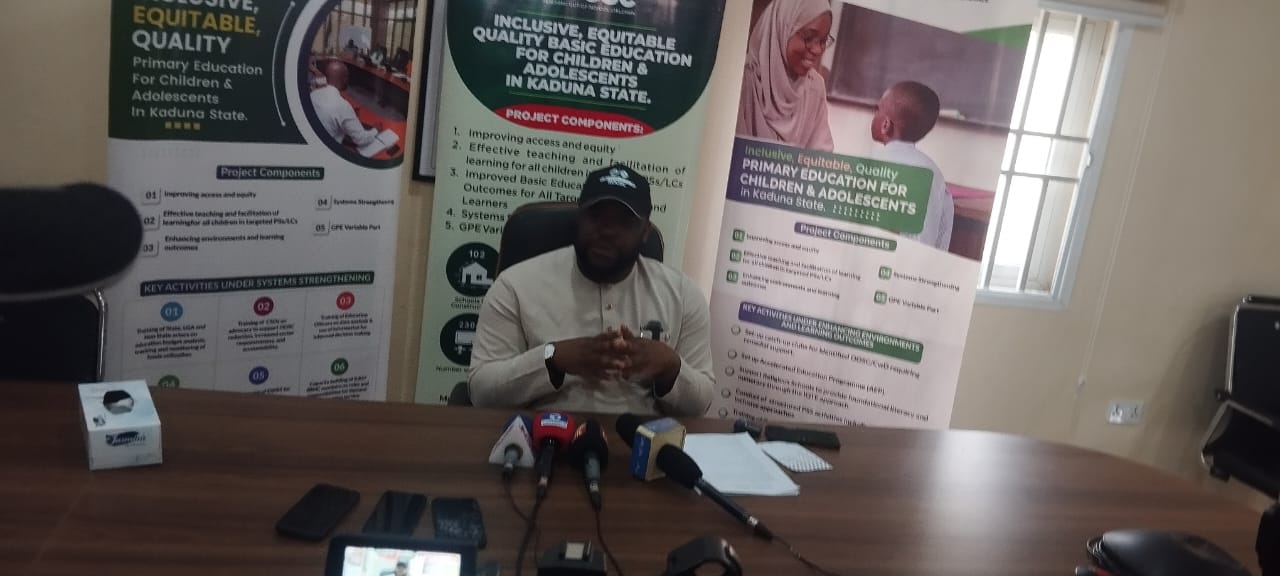
Ezra Angai, Project Coordinator for Kaduna’s ROOSC initiative, announced this on Friday during a media briefing in Kaduna to commemorate International Literacy Day 2026.
Angai explained that the 2026 celebration, observed worldwide on September 8th, marks 60 years since the first International Literacy Day was declared in Tehran, Iran, in 1966. While recognizing the progress made over the decades, he highlighted that UNESCO data reveals 739 million people globally are still illiterate, including over 400 million girls, mostly from rural and remote communities.
“Literacy has evolved. Your ability to read and write alone isn’t enough to navigate a complex world. Today, we’re talking about a world of AI, digital media, and technical and vocational skills,” Angai stated.
He clarified that the theme for 2026, “Literacy for People, Literacy for Planets, and Literacy for Prosperity,” underscores the importance of equipping individuals not just to read, but to earn, adapt, and contribute meaningfully to society.
Regarding Nigeria’s challenge, Angai reported that UNICEF estimates about 18 million children are out of school. He praised the Federal Government’s efforts under the Renewed Hope Agenda and the Minister of Education, Dr. Tunji Alausa, for implementing data-driven reforms, including digital data collection through the 2025/2026 Annual School Census.
Angai emphasized that Kaduna is taking a leading role nationwide. “Kaduna was the first Nigerian state to collect over 98% of its data using the D-NEMIS system,” he noted, adding that the state allocates over 25% of its annual budget to education, far exceeding UNESCO’s recommendation of 15-20%, and the national average of 6%.
Central to the state’s strategy is the $62.8 million ROOSC project, the only comprehensive state-led initiative targeting out-of-school children in Nigeria. The project is supported by development partners such as the Islamic Development Bank, Kuwait Fund for Arab Economic Development, Global Partnership for Education, Education Above All, Save the Children International, and UNICEF.
Angai detailed that the project started with one of Nigeria’s most thorough mapping exercises, visiting 360,000 households and identifying 187,719 out-of-school children, documenting their names, addresses, and reasons for dropping out.
“Over 90% of our out-of-school children are out of school because of household issues. More revealing, about 57% of that group are boys who work on farms or in other ventures,” he said.
To address these issues, Kaduna is constructing 102 new schools and renovating 170 existing ones. Angai added that 42 sites are currently operational, including 16 new schools. Beyond traditional classrooms, the project integrates Sangayas into the education system by providing foundational literacy, numeracy, and life skills. For overage children aged 11 to 17, the Accelerated Basic Education Program (ABEP) compresses basic education into two years and six months.
Additional measures include distributing 44,000 teaching and learning materials, uniforms, and over 2,000 menstrual hygiene kits for girls. In insecure areas, the project utilizes radio-based lessons.
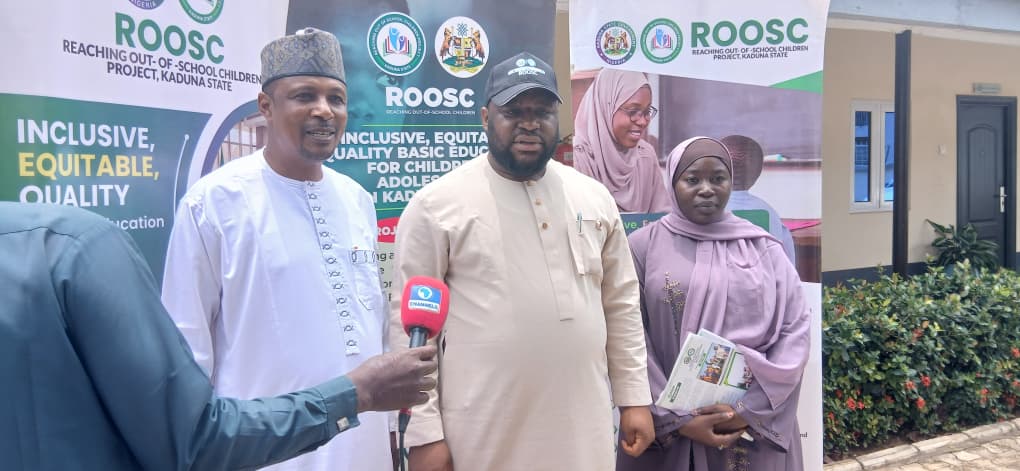
Angai also noted that the project conducted disability assessments in collaboration with Save the Children International and provided assistive devices. He shared the story of “Israel,” a boy with weakened limbs who received a wheelchair and a standing frame for physiotherapy. This support improved his mobility and helped his mother care for his siblings.
A major innovation, Angai explained, is the use of Community Coalitions to promote enrollment and retention. Composed of traditional rulers, religious leaders, SBMC chairpersons, and parents, these coalitions collaborate with trained caseworkers linked to school clusters.
He cited an example of a girl who stopped attending school after her parents’ separation. “The caseworker reported to the community coalition; they went to the house and engaged the father. The village head intervened, and they reached a compromise. The girl is back in school,” Angai said.
To ensure accountability, the project implements a four-tier monitoring system: a digital database to track every mainstreamed child; weekly and monthly reviews by Save the Children; caseworker visits; and quarterly joint monitoring by the PMU, SUBEB, Quality Assurance, the Ministry of Education, and partners.
Angai added that the Minister of Education has expressed interest in adopting Kaduna’s mapping model nationwide.
“Is the funding sufficient? It is enough for us to implement this program and re-enroll 100,000 out-of-school children over the next four years,” he stated.
He wrapped up by reaffirming the project’s motto: “Every child deserves access to quality and inclusive education.”