


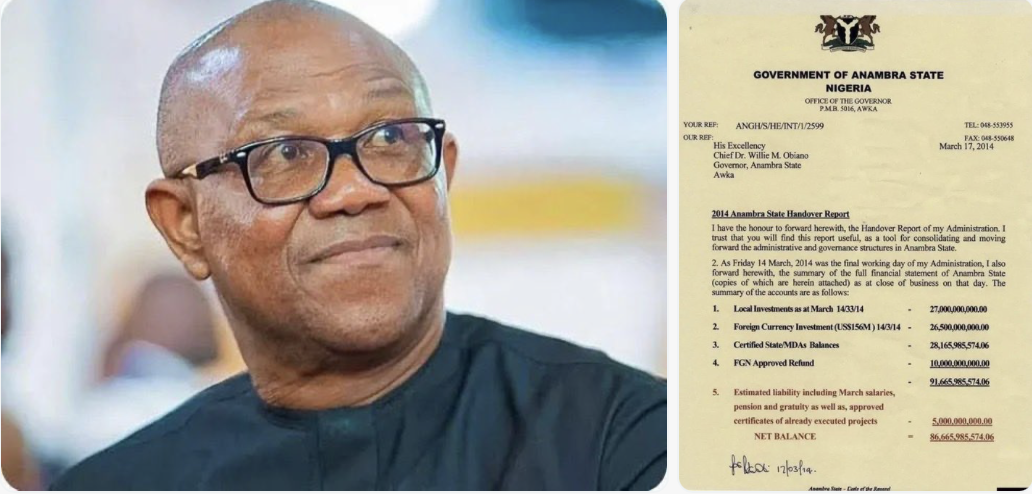
Yunusa Tanko publishes document showing reported net balance of ₦86.67bn as Anambra government says Obi left loans still being serviced
The National Coordinator of the Obidient Movement, Yunusa Tanko, has released a copy of former Anambra State Governor Peter Obi’s 2014 handover report, adding a new document to the ongoing dispute over the state’s finances when Obi left office.
Tanko shared the document on X on Wednesday, September 16, 2026, amid an escalating exchange between Obi and the Anambra State Government over loans and other financial obligations allegedly inherited from previous administrations. The development was reported by multiple Nigerian news organisations on September 17.
What the 2014 document says
The document, dated March 17, 2014, was addressed by Obi to his successor, former Governor Willie Obiano, and summarised Anambra State’s financial position as of the close of business on March 14, 2014, which was described as the final working day of Obi’s administration.
According to the document reproduced in current reports, Obi listed:
- Local investments — ₦27 billion
- Foreign currency investment of US$156 million — valued at ₦26.5 billion
- Certified state/MDAs balances — ₦28.166 billion
- Federal Government-approved refund — ₦10 billion
These figures amounted to ₦91.666 billion, according to the document. It also listed estimated liabilities of ₦5 billion, covering March salaries, pensions, gratuities and approved certificates for already executed projects.
After deducting the stated liabilities, the document recorded a “NET BALANCE” of ₦86,665,985,574.06.
In the covering letter, Obi said he was forwarding the summary of the state’s full financial statement to Obiano as of the close of business on March 14, 2014.
Tanko challenges former governors
In a statement accompanying the document, Tanko challenged former governors of Anambra State to make their respective handover documents public.
“Let other governors, from 1999 till date, have the courage to publish their handover notes to their successors. Be accountable to the people,” he said, according to Vanguard.
The publication of the document comes as the financial record of the Obi administration has become a major point of contention between Obi and the current Anambra State Government.
Anambra government gives a different account
The Anambra State Government has maintained that loans contracted under previous administrations, including the Obi administration, remain part of the state’s financial obligations.
In a statement on Wednesday, Commissioner for Information and Value Reorientation Law Mefor said the state had identified eight external borrowings which it attributed to the Obi administration.
According to the government, the outstanding balance of those loans stood at ₦127.4 billion as of June 30, 2026, using the official exchange rate. The government said the loans were taken for areas including malaria control, erosion management, education and healthcare.
The state government’s position therefore concerns loan liabilities, while the handover document released by Tanko presents a broader financial position that includes investments, balances and an approved Federal Government refund.
Obi rejects claims that he left unpaid obligations
Obi has rejected claims that his administration left Anambra with unpaid salaries, pensions, gratuities or liabilities to contractors for duly executed and certified projects.
He has challenged anyone disputing his account to produce evidence to the contrary.
The former governor has also questioned the state’s handling of other funds he says were available when he left office.
The document does not settle the debt dispute
The 2014 handover document provides evidence of what Obi’s administration reported as the state’s financial position at the time of handover, but its publication does not by itself establish that Anambra had no outstanding loans.
The current dispute involves different categories of financial obligations, including external loans, investments, cash balances, project liabilities and other commitments. Determining which obligations were outstanding at the time of handover and which administration incurred or repaid them requires examination of the underlying loan agreements, debt records and official financial statements.
An earlier 2014 handover committee report also shows that the committee examined the state’s financial status and outstanding obligations, although it noted difficulties obtaining complete information for a composite assessment of the state’s financial position.