


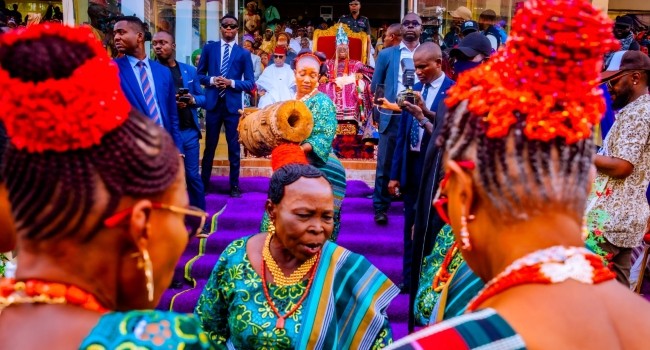
Hundreds of years ago, Oba Awamaro, the Ewi of Ado-Ekiti, gathered his people beneath the wide branches of an Iroko tree in the royal palace to give thanks to their creator, Olorun.
That gathering around 1310 AD gave birth to the Udiroko Festival (under the Iroko tree), which is nicknamed Olorunborun. That shade of the original tree lives on hundreds of years later and now brings people from around the globe together in Ado-Ekiti, Ekiti State.
It marks the new year for the people and gives them a chance to see their monarch, who is traditionally restricted from regular public appearances, as required by his office.
Centuries after that inaugural gathering under the Iroko tree at the Ewi’s palace, the festival remains unchanged and continues to serve as a melting point for sons and daughters of Ado-Ekiti.
The Udiroko festival starts across households as families feast on pounded yam, egusi soup, and emu aroso (undiluted palm wine). The people of Ado-Ekiti, dressed in their best attire, head to the palace to get a glimpse of the monarch.

At the 2026 edition, the Ewi’s courtyard came alive with the display of Ado-Ekiti’s rich culture. Warlords from different towns and villages under the Ewi’s domain come into the arena with gifts to the Olokunaye. These gifts – usually Asala (walnuts) and obi (kola nuts) – are then shared by the people, after which the monarch addresses the warlords.
Beyond the spectacle, Udiroko acts as a vital engine for civic progress: age grades are periodically relaunched to organise youth for community service, and major fundraising drives take place to construct lasting civic infrastructure.

Importantly, the festival culminates in the Iwure—the paramount monarch’s royal prayers and address. His address sets the tone for the direction the community is taking in the new year and also serves as a review of the past year, giving a sense of purpose and progress.

Setting the policy, development budget, and vision for the coming year, the Ewi’s words carry deep spiritual weight, encapsulated in the ancient local adage: “Ohun Ewi aye bati wi ni Egba Orun n gba”—whatever the Ewi on earth speaks, the Heavens accept.
At the 2026 festival, the ancient square transformed once again into a vibrant arena of homage, traditional displays, and royal blessings.
In his address, the Ewi of Ado–Ekiti, Oba Adeyemo Adejugbe, described the Udiroko festival as a significant cultural heritage of the people of Ado Ekiti and stressed the need for its preservation and promotion for future generations.
The monarch commended the people of the community for the annual celebration and for using the festival to promote unity, cultural values, and peaceful coexistence.
He also thanked Governor Biodun Oyebanji for his administration’s support for the festival and other initiatives, including increasing the number of tarred roads in Ado-Ekiti.
The Ewi also congratulated the governor on his re-election, describing his victory as a well-deserved endorsement of his administration’s performance and the confidence the people of Ekiti State have in his leadership.
The traditional ruler asked Nigerian security organs at all levels to do more to ensure the safety of citizens, maintaining that they must employ technological craftiness and ruthless sophistication to arrest the unrepentant onslaught of bandits terrorising the country.

On his part, Governor Biodun Oyebanji reiterated his administration’s commitment to positioning Udiroko and other cultural celebrations across the state as major drivers of tourism and economic growth.
“I rejoice with all of us on this occasion. I felicitate with Kabiyesi, Eyesorun, and all the Chiefs; my prayer is that you will celebrate more on this throne and celebrate many Udiroko festivals,” Oyebanji said. “The Udiroko festival is no longer an Ado festival; it has become an Ekiti festival, and we need to sit down with the planning committee to find a way such that while we are preserving our culture and tradition, we also use this festival as an avenue to create wealth for Ekiti indigenes.”

He assured that his government would continue to support cultural initiatives capable of attracting visitors, generating income, and improving the livelihoods of the people across the state.
As the echoes of the drums fade and another year begins for the people of Ado-Ekiti, the spirit of Udiroko remains steadfast. It is a reminder that no matter how far its sons and daughters of Ado-Ekiti wander, the roots planted under the Iroko tree continue to pull them back home.
CHANNELS