


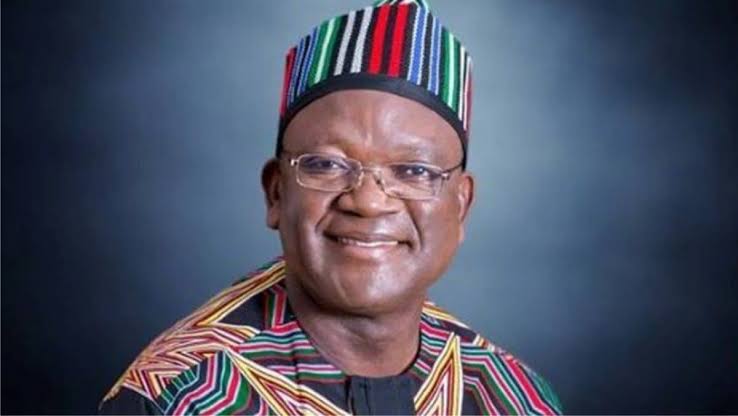
From endorsing Peter Obi in 2023 to backing Tinubu in 2027, while maintaining ties across political divides, Samuel Ortom’s recent moves raise questions about the former Benue governor’s political calculations ahead of the 2027 elections.
Politics is often described as a game of interests, alliances and shifting calculations. In Nigeria, where political loyalties frequently transcend party lines, politicians can move from one political camp to another without necessarily seeing such movements as contradictions.
Few recent political trajectories illustrate this better than that of former Benue State Governor, Samuel Ortom.
In February 2023, Ortom, then a sitting governor elected on the platform of the Peoples Democratic Party (PDP), openly declared his support for Peter Obi, the Labour Party presidential candidate.
Three years later, the same Ortom has publicly declared his support for President Bola Ahmed Tinubu’s bid for a second term in 2027.
Yet, when Obi recently visited Benue, Ortom reportedly made his personal vehicle available to the former Anambra governor and presidential candidate and defended his visit to the state.
Against the background of an emerging political understanding between elements of the PDP and the All Progressives Congress (APC) associated with Senator George Akume, Ortom’s political positioning has become a subject of considerable interest.
The Obi declaration that shook the PDP
On February 16, 2023, at a town-hall meeting in Makurdi, Ortom made one of the most consequential political declarations of his tenure as governor.
While remaining a member of the PDP, he openly distanced himself from the party’s presidential candidate and threw his weight behind Peter Obi.
“I am not in Labour Party but I am working for Peter Obi,” Ortom declared.
He argued that Nigerians needed to look beyond political parties, ethnicity and religion and concentrate on the character and competence of the individuals seeking to lead the country.
He also said Nigeria needed a new direction founded on equity, fairness and justice.
In a Press statement that captured the political significance of his intervention, Ortom said the PDP and APC had failed Nigerians and urged voters to consider the candidate they believed could provide effective leadership.
He was particularly emphatic about Obi.
“Of the three presidential candidates, Peter Obi has the character, competence to lead Nigeria,” he said.
It was a remarkable position for a sitting PDP governor.
Ortom was not merely expressing admiration for Obi. He was openly telling voters that, despite being a PDP governor, he was working for the Labour Party candidate.
From Obi to Tinubu
The political landscape changed dramatically after the 2023 election.
Peter Obi did not win the presidency. Bola Tinubu emerged as president, while the PDP’s Atiku Abubakar finished behind him.
The political calculations of the G5 governors also began to assume a new dimension.
By January 2024, Ortom was publicly associated with the position that the G5 governors would support Tinubu’s re-election in 2027.
At a gathering in Port Harcourt, Ortom spoke about the decision of the G5 and the political position of Nyesom Wike, who had become a minister in Tinubu’s administration.
The former Benue governor subsequently made his own position increasingly clear.
The man who had told Nigerians in 2023 that Obi had the character and competence to lead Nigeria was now supporting the president whom he and the G5 political bloc had helped emerge from the 2023 political crisis.
It is this transition that provides the foundation for the debate over Ortom’s political consistency.
“If you can’t beat them, you join them”
Ortom later offered his own explanation for the change.
Reflecting on the political developments after the 2023 election, he said:
“In 2023, I supported Obi. But when Nigeria spoke, and President Tinubu was president, I said, ‘If you can’t beat them, you join them.’ And we did.”
He subsequently stated that he and his political associates in Benue were working for Tinubu and explicitly declared qhis support for the president’s 2027 bid.
The statement was significant because it appeared to close the political chapter that began with his 2023 endorsement of Obi.
But recent events suggest that the chapter may not be as closed as it first appeared.
The return of Peter Obi to Benue
When Peter Obi returned to Benue during his recent visit to the state, the political symbolism was difficult to miss.
Ortom, despite his declared support for Tinubu in 2027, made his vehicle available to Obi.
The gesture immediately generated political controversy.
Critics questioned why a politician who had publicly declared support for Tinubu would provide such assistance to one of the president’s potential political opponents.
Ortom’s explanation, however, was straightforward.
Through his media aide, Terver Akase, he said the gesture was one of courtesy and hospitality.
Obi, according to the explanation, was a former governor and presidential candidate visiting Benue on a humanitarian mission.
Refusing him transportation, Ortom argued, would have been petty and beneath the dignity expected of a former governor.
Ortom also defended Obi’s right to visit communities affected by violence and sympathise with victims.
From that perspective, the former governor’s action was not necessarily an endorsement of Obi’s 2027 presidential ambition.
But politically, appearances matter.
The man whose vehicle carried Peter Obi is the same man who once declared that Obi possessed the character and competence to lead Nigeria.
And he is also the same man who now says he is backing Tinubu.
Where does George Akume fit into the equation?
The story becomes even more intriguing when Senator George Akume enters the picture.
Akume, a former governor of Benue State and currently Secretary to the Government of the Federation, remains one of the most influential political figures in the state’s APC structure.
Ortom and Akume have had a long and often bitter political history.
Yet, as the 2027 elections draw closer, political boundaries appear to be shifting.
Ortom has spoken openly about the possibility of a strategic partnership involving political forces beyond the PDP.
He has also acknowledged Akume’s influence in Benue politics.
“I am not leaving PDP, but we can do strategic partnership,” Ortom said.
He has also described Akume as the leader of Benue politics and spoken of a “give-and-take arrangement.”
That development is particularly important because of the growing political tension surrounding Governor Hyacinth Alia and the APC structure in Benue.
The emerging alignment appears to be less about traditional party ideology and more about political interests and the struggle over who controls the state’s political machinery going into 2027.
PDP, APC and the politics of convenience
This is where Ortom’s political journey begins to look less like a simple change of allegiance and more like a calculated political chess game.
In 2023, he was a PDP governor working for an opposition presidential candidate.
In 2024, he was associated with the G5’s support for Tinubu.
By 2026, he was openly backing Tinubu’s 2027 ambition while simultaneously maintaining a cordial political relationship with Peter Obi.
At the same time, he has indicated his willingness to work strategically with political forces associated with Akume.
In conventional party politics, these positions might appear contradictory.
But Nigerian politics has never been entirely governed by party ideology.
Politicians often form alliances around personalities, interests, elections and political survival.
The real question, therefore, may not be qwhether Ortom has contradicted himself.
It may be whether he is deliberately keeping multiple political doors open.
Double standard or political pragmatism?
For Ortom’s critics, the pattern represents a double standard.
They may ask: if Peter Obi was the candidate with the character and competence to lead Nigeria in 2023, why is Tinubu now the candidate Ortom believes Nigerians should support in 2027?
If Tinubu is the preferred candidate, why maintain such a close public relationship with Obi?
And if Ortom remains a PDP chieftain, what exactly does his strategic relationship with Akume’s APC faction mean?
These are legitimate political questions.
But Ortom’s supporters can offer a different interpretation.
They can argue that political support is not necessarily permanent and that circumstances change.
They can point out that providing a vehicle to Obi does not amount to endorsing Obi’s presidential ambition.
They can also argue that a strategic partnership with politicians from another party is a normal feature of democratic politics.
In that interpretation, Ortom is not being inconsistent; he is simply operating within the realities of Nigerian politics.
The bigger 2027 calculation
What makes Ortom’s political movement particularly important is that the 2027 contest in Benue may not be determined solely by the traditional PDP-versus-APC rivalry.
The emerging political alignments suggest that personalities and political blocs may prove more important than party labels.
The relationship between Ortom’s PDP network and Akume’s political structure could therefore become a major factor in determining the direction of the state’s politics.
At the national level, Ortom’s support for Tinubu places him within the president’s wider political coalition.
At the state level, his relationship with Akume creates another potential bridge across party lines.
And his continued cordiality with Peter Obi demonstrates that political relationships can survive even after presidential alliances have changed.
A politician keeping his options open?
Perhaps the safest conclusion is that Samuel Ortom is keeping his political options open.
His 2023 declaration demonstrated that he was willing to defy his party when he believed another candidate represented a better political option.
His subsequent support for Tinubu demonstrated his willingness to adjust to the political realities created by the 2023 election.
His recent defence of Peter Obi’s visit and provision of his vehicle demonstrate that political disagreement does not necessarily mean personal hostility.
And his willingness to contemplate strategic cooperation with forces associated with George Akume suggests that, ahead of 2027, old political enemies can become temporary allies when interests converge.
Whether this constitutes political pragmatism or a double-standard game will ultimately depend on how voters interpret the pattern.
For some, Ortom is simply demonstrating political maturity by maintaining relationships across party lines.
For others, his journey from “I am working for Peter Obi” to “I am backing President Tinubu”, while simultaneously facilitating Obi’s movement in Benue and exploring strategic partnerships with Akume’s political camp, raises questions about political consistency.
Whatever interpretation eventually prevails, one thing is certain: Samuel Ortom remains an important piece on Benue’s 2027 political chessboard.
And as the election draws closer, the alliances he chooses to strengthen — and the ones he chooses to keep alive — may tell Nigerians more about his political strategy than any single declaration.