


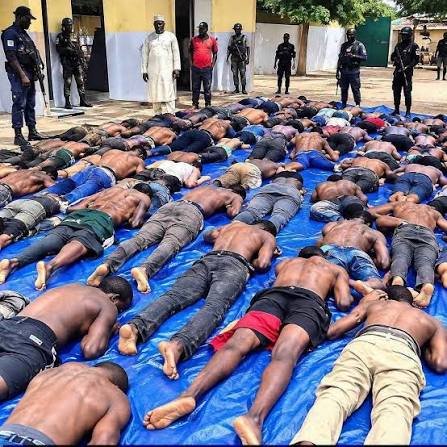
The search for gold in Niger State has ended in tragedy, leaving behind 37 dead bodies, grieving families and difficult questions about the treatment of suspected illegal miners in government custody.
On September 17, 2026, news broke that 37 people suspected of illegal mining had died while in the custody of the Nigeria Security and Civil Defence Corps (NSCDC) in Minna, the Niger State capital. The victims had reportedly been arrested during enforcement operations against illegal mining in the Wushishi/Lukoto axis of the state.
What began as a government operation aimed at confronting illegal mining has now developed into a major human-rights and accountability issue, with questions being raised about what happened inside the detention facility and whether the deaths could have been prevented.
The NSCDC said it had arrested scores of suspected illegal miners during operations in the area. The agency initially attributed the deaths to a suspected disease outbreak but later acknowledged that the exact cause of death had not been established.
Other accounts have raised different possibilities.
Survivors interviewed by international media said the detainees were held in an overcrowded cell and experienced difficulty breathing before people began collapsing. Some survivors also alleged that an unidentified substance was sprayed into the cell, although the reports could not independently verify those claims or determine what substance, if any, had been used.
An intelligence report cited by AFP also suggested that overcrowding and inadequate ventilation could have contributed to the deaths. These accounts, however, remain allegations and preliminary findings rather than established facts.
The uncertainty surrounding the exact cause of death has consequently become one of the central issues in the controversy.
The Federal Government has moved to investigate the circumstances surrounding the deaths, with President Bola Ahmed Tinubu directing a comprehensive investigation. The Minister of Interior, Olubunmi Tunji-Ojo, subsequently constituted a 10-member independent committee to investigate the incident.
The government also suspended officers connected to the incident pending the outcome of the investigation. The committee was given two weeks to complete its work and submit its report.
At the same time, the Federal Government has maintained that its campaign against illegal mining will continue because of the security, environmental and economic consequences associated with unlawful mining activities. However, officials have stressed that enforcement must be conducted within the law and that anyone found responsible for wrongdoing will face appropriate consequences.
Minister of Information and National Orientation Mohammed Idris said the government would not shield anyone found culpable, while cautioning against reaching conclusions before the investigation is completed.
That position places two responsibilities before the government: the need to confront illegal mining and the obligation to protect the fundamental rights and dignity of people arrested during enforcement operations.
The deaths have attracted particular concern because the victims died while under state custody.
Nigeria’s National Human Rights Commission has commenced its own preliminary investigation and called for an independent forensic autopsy and the preservation of evidence. The commission has stressed the importance of ensuring that investigations into potentially unlawful deaths in custody meet national and international standards.
The human-rights dimension is significant because being arrested on suspicion of illegal mining does not remove a person’s constitutional rights. Suspects in custody remain entitled to humane treatment and appropriate medical attention.
Illegal mining itself remains a serious challenge for Nigeria. It has implications for environmental degradation, public safety, government revenue and insecurity. But enforcing laws against illegal mining does not remove the state’s responsibility to protect the lives of people in its custody.
The incident has also attracted international attention. Amnesty International Nigeria has called for an immediate investigation into the deaths and urged the authorities to establish what happened to the detainees.
International media reports have similarly highlighted concerns about the detention conditions, survivor accounts and the need for an independent determination of the cause of death.
The international dimension of the tragedy goes beyond the deaths themselves. Niger State’s gold and other mineral resources are connected to wider regional and global supply chains.
Illegally mined gold can enter international markets through smuggling routes, while Nigeria’s deposits of minerals such as lithium and tantalite are becoming increasingly important to the global economy.
This makes illegal mining more than a local Nigerian problem. It sits at the intersection of poverty, youth unemployment, organised crime, environmental protection, mineral governance and international demand for raw materials.
For many young people living in mineral-rich communities, artisanal mining can represent one of the few available sources of income. Yet the sector can also expose workers to dangerous conditions and exploitation.
In parts of Nigeria, authorities and experts have linked illegal mining to criminal networks and armed groups that control mining sites or impose levies on miners.
The challenge for government, therefore, extends beyond arresting miners. It involves addressing the economic conditions that drive people into unregulated mining, expanding legal opportunities for artisanal miners, preventing criminal exploitation of mineral resources and ensuring that valuable minerals do not disappear into illicit international supply chains.
The deaths have also produced public anger in Minna. Protests followed the announcement, with reports of clashes and attacks on government property. Niger State authorities subsequently imposed a 24-hour curfew as tensions escalated.
The state government also declared three days of mourning following the deaths.
For the families who lost relatives, however, the central question remains painfully simple: what happened to their loved ones while they were in government custody?
For the government, the answer must come through investigation and evidence. For human-rights organisations, the deaths raise questions about accountability, detention conditions and the state’s duty of care.
For the international community, the incident offers another reminder of the human cost that can accompany weak regulation of mineral extraction and the movement of minerals through global supply chains.
The independent investigation will therefore be crucial. It must establish how the detainees died, the conditions in which they were held, whether established detention procedures were followed, whether any officers breached their responsibilities and whether criminal or administrative action is warranted.
It must also address the competing accounts surrounding the deaths without prematurely adopting any explanation.
Until those questions are answered, the 37 deaths will remain more than a tragedy linked to illegal mining. They will represent a test of Nigeria’s commitment to enforcing its mining laws while also protecting the rights and dignity of people in state custody.
The gold that drew miners into Niger State may have been buried beneath the ground. But the questions arising from their deaths can no longer be buried with them.