


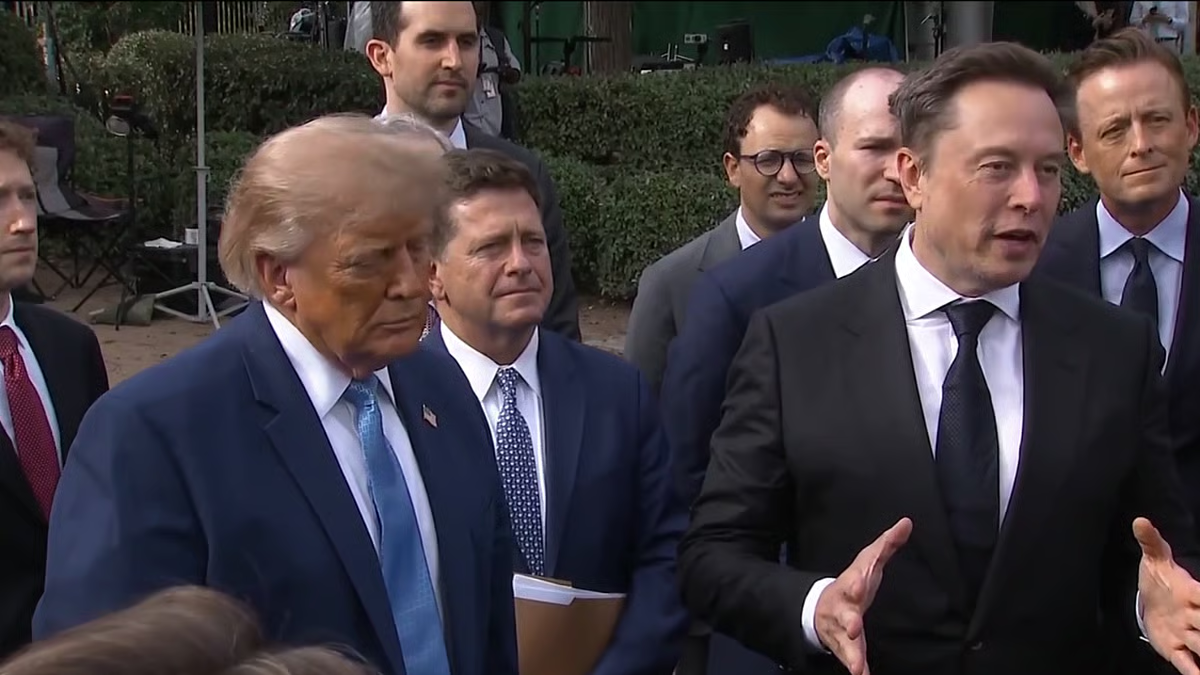
Tesla and SpaceX CEO Elon Musk has said artificial intelligence and robotics will significantly change the nature of employment, while US President Donald Trump has highlighted China’s growing interest in data-centre infrastructure needed to power advanced AI systems.
Musk made the comments on Tuesday, September 29, 2026, at the White House after Trump met with leading technology executives to discuss artificial intelligence, safety and the expansion of computing infrastructure in the United States.
Asked about concerns that artificial intelligence could eliminate jobs, Musk said employment would evolve as machines become capable of performing more tasks traditionally handled by people.
“Jobs are going to change,” Musk said, adding that he expected an “evolution of roles” as AI and robots become more widely used across different fields.
Musk compared the expected transition with earlier technological changes, noting that some occupations disappeared or changed when computers took over tasks previously performed manually. He argued that the likely outcome of increasingly capable AI and robotics would be beneficial rather than a permanent collapse in employment.
“I think the most likely outcome, and it’s probably worth looking at the most likely outcome, is one which is incredibly beneficial,” Musk said. “If you could look into the future, it is the future you would want.”
His comments came as the administration brought together executives from some of the world’s largest technology companies for discussions about AI development and safety. Executives from OpenAI, Google, Meta, Nvidia, Anthropic and xAI were among those involved in the meeting.
The technology leaders also agreed to a voluntary framework covering AI safety practices. The agreement calls for participating companies to establish internal controls, conduct risk reviews and work with independent external auditors, with company boards expected to review audit findings. Reuters reported that the agreement is voluntary rather than legally binding.
While Musk focused on the future of work, Trump used the same event to discuss the infrastructure required to support AI development and the competition between the United States and China.
Trump said he and Musk had discussed data centres with Chinese President Xi Jinping during their recent meeting. He said China would be interested in taking data-centre capacity that was not ultimately developed or used in the United States.
“They want every data center. They want it because that’s great for China,” Trump said, referring to China’s interest in the infrastructure.
The comments reflect the growing importance of data centres in the global AI race. Advanced AI systems require large amounts of computing power, which in turn requires substantial investments in data centres, semiconductors and electricity infrastructure.
Independent industry analysis also points to rapid growth in China’s data-centre capacity. Rystad Energy estimates that China had about 32 gigawatts of installed data-centre capacity at the end of 2025 and expects another 28 gigawatts from projects scheduled to come online by 2030, although those projections depend on the projects being completed.
The White House meeting therefore brought together two connected issues in the AI debate: how increasingly capable machines could affect employment and how governments and companies will build the infrastructure required to operate them.
Musk’s comments did not suggest that employment would remain unchanged. Instead, he described a transition in which existing occupations could be transformed while new roles emerge alongside increasingly capable AI systems and robots.
Other technology executives at the meeting offered additional perspectives on the technology’s risks and benefits. Anthropic CEO Dario Amodei, for example, said AI has significant potential benefits but also “very real risks,” while Meta CEO Mark Zuckerberg described the voluntary safety framework as an initial step rather than a complete solution.
The discussion comes as governments and technology companies continue to debate how quickly AI should develop, how its risks should be managed and how the economic gains from the technology should be distributed.
For workers, the central question raised by Musk’s remarks is not whether AI will affect employment, but how occupations, required skills and workplace responsibilities will change as businesses increasingly incorporate artificial intelligence and robotics into their operations.