


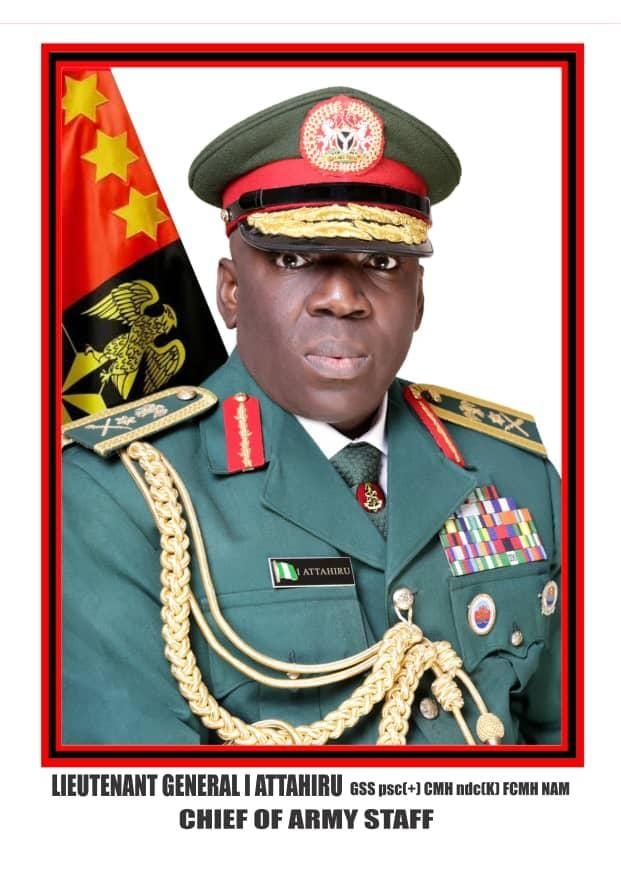
It was a tenure measured not in years, but in days. Yet, those days burned with purpose.
On May 21, 2021, Nigeria lost one of its finest soldiers when Lt. Gen. Ibrahim Attahiru, the 25th indigenous Chief of Army Staff, died in a plane crash in Kaduna alongside ten other gallant officers. He had been in office for barely four months. Five years after, his name still echoes in barracks, battlefronts and the memory of a nation that watched him try to reset a war-weary Army.
Attahiru was not a stranger to battle. He was a soldier’s soldier.
A veteran of ECOMOG operations in Liberia and United Nations peacekeeping in Sierra Leone, he understood the language of guns and the burden of peace. At home, his footprints cut across Nigeria’s most difficult terrains. He commanded the 146 Battalion in Bakassi at a time when militancy tested the soul of the creeks, led the 13 Brigade, steered the 82 Division, and at the height of insurgency, commanded Operation Lafiya Dole in the North-East.
Behind the desk, he was equally impactful as Chief of Defence Logistics and later as Chief of Defence Transformation and Innovation, where he drove operational planning and institutional reforms that quietly reshaped the Armed Forces.
But it was as Chief of Army Staff that Attahiru revealed his boldest self.
He arrived when morale was low and insecurity was spreading. He did not offer excuses. He gave orders. Clear, urgent, and purposeful.
Within weeks, he issued a 48-hour ultimatum to troops to recapture Marte, a strategic town in Borno State that had fallen to insurgents. They did. It was a statement: a new sheriff was in town.
He restructured the entire counterinsurgency architecture, birthing Operation Hadin Kai from the ashes of Lafiya Dole, a move that strengthened synergy and jointness among services. He pushed for stronger inter-agency cooperation, believing no single uniform could win Nigeria’s complex wars alone.
And he remembered the men in the trenches. Attahiru prioritised welfare with rare empathy, pushing for improved accommodation for frontline troops and insisting that soldiers who fight for the country must be treated with dignity.
Then, death came. Sudden. Cruel. Unfinished.
As Nigeria also mourns the late Lt. Gen. T.A. Lagbaja, Attahiru’s memory reminds us of the fragility of service and the permanence of sacrifice.
His vision for a professional, motivated and combat-ready Nigerian Army was cut short, but his reforms outlived him. The operational templates he approved, the welfare conversations he reignited, and the fighting spirit he reawakened remain part of today’s Army.
Five years on, the lessons are clear: leadership is not about longevity, but impact.
May Almighty Allah forgive his shortcomings, grant him Aljannatul Firdaus, and comfort the families of all the gallant officers and men who paid the supreme price with him.
Sleep on, General. Nigeria will not forget you.