


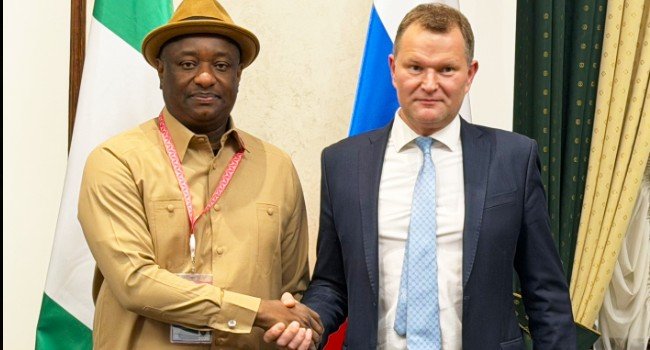
Nigeria and Russia have agreed to renegotiate their 59-year-old Bilateral Air Services Agreement (BASA), setting a six-month deadline to conclude discussions and sign a new agreement in April 2027.
The decision followed a high-level bilateral meeting held on Friday, October 30, on the sidelines of the Third Russia-Africa Summit in Moscow. Nigeria’s Minister of Aviation and Aerospace Development, Festus Keyamo, led the Nigerian delegation, which met with Dmitry Stanislavovich Zverev, State Secretary and Deputy Minister of Transport of the Russian Federation.
According to a statement issued by the Federal Ministry of Aviation and Aerospace Development, both countries agreed that the existing agreement, which dates back to 1967, should be modernised to reflect developments in international aviation and emerging opportunities in the air transport industry.
Keyamo said the two sides had agreed to conclude negotiations within six months and sign the replacement agreement in Saint Petersburg, Russia, in April 2027. Both countries have also constituted negotiating teams to begin work immediately and meet the agreed timeline.
The proposed agreement is expected to establish an updated framework for air transport relations between Nigeria and Russia, potentially creating opportunities for improved connectivity, closer institutional collaboration and greater engagement between their aviation industries.
Bilateral Air Services Agreements provide the legal framework governing international air services between two countries. They generally address issues such as designated airlines, flight routes, traffic rights and the conditions under which carriers can operate between participating countries.
However, the Nigerian government has not yet announced specific routes, airlines or flight frequencies that could emerge from the proposed agreement. Any new commercial services would also be subject to the relevant regulatory and operational approvals.
Nigeria’s delegation included the Director-General of the Nigerian Civil Aviation Authority (NCAA), Captain Chris Najomo; the Registrar of the Nigerian College of Aviation Technology (NCAT), Dr Danjuma Adamu Ismaila; and directors from the Federal Ministry of Aviation and Aerospace Development and the NCAA.
Beyond the review of the aviation agreement, the discussions also covered other possible areas of cooperation between the two countries. Both delegations expressed interest in examining additional opportunities in aviation and related sectors in the coming months.
The renegotiation forms part of broader efforts to strengthen Nigeria-Russia relations through economic, technical and institutional cooperation. The two countries have maintained diplomatic relations for decades, with collaboration extending across areas including education, defence, science and technology.
For Nigeria, an updated aviation agreement could provide a basis for expanding international air transport partnerships and exploring new connections with Russia. The extent of any benefits, however, will depend on the final terms negotiated, the commercial interest of airlines and the readiness of both countries’ aviation infrastructure.
The six-month negotiation period now sets a clear timetable for the next stage of the process, with both governments targeting the signing of a new Bilateral Air Services Agreement in Saint Petersburg in April 2027.