


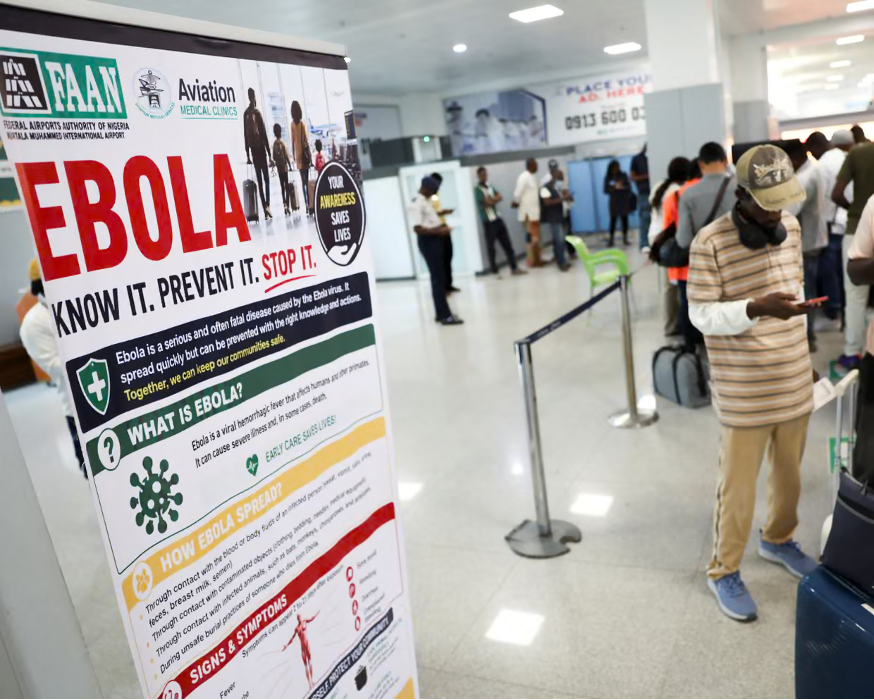
The Swiss government has said that the Ebola patient receiving treatment in Nigeria did not travel to the Democratic Republic of the Congo (DRC), contradicting earlier claims by Ugandan authorities about her travel history.
In a statement to Reuters on Friday, Switzerland’s Federal Department of Foreign Affairs confirmed that the woman and her husband, a Swiss diplomat based in Abuja, had not visited the DRC. The department had earlier identified the patient as a Swiss national and said she was believed to have contracted the virus while travelling in Uganda.
The clarification follows conflicting accounts of the woman’s movements before she tested positive for Ebola in Nigeria. Ugandan authorities had claimed that she travelled to eastern DRC, where the current outbreak began, before passing through Uganda.
However, the World Health Organisation (WHO) and the Africa Centres for Disease Control and Prevention (Africa CDC) said they had not received verified information confirming that she visited the DRC.
The WHO said the information available to it showed that the patient had been in Uganda from September 16 and returned to Abuja on October 3. Investigators are working to reconstruct her travel history and determine where she may have been exposed to the virus.
Nigeria confirmed its first Ebola case in more than a decade on October 20, after laboratory tests detected the Bundibugyo virus in a Swiss national receiving treatment in Abuja. She developed symptoms on October 7 and sought medical attention in Abuja four days later. Nigerian authorities have since activated contact-tracing and containment measures.
Read our earlier report on Nigeria’s Ebola case and the emergency response for more details.
Nigerian health authorities have identified 44 contacts for monitoring as part of efforts to prevent further transmission. The patient’s husband has also been isolated as a precaution, although reports indicated that he had not developed symptoms.
The case has raised concerns about the spread of the outbreak across African countries, with infections reported in the DRC, Kenya, Uganda and Nigeria.
Health officials are continuing investigations to establish the source of the Nigerian patient’s infection. Authorities have stressed the importance of verified travel information and cross-border cooperation in tracing possible exposures and containing the disease.