


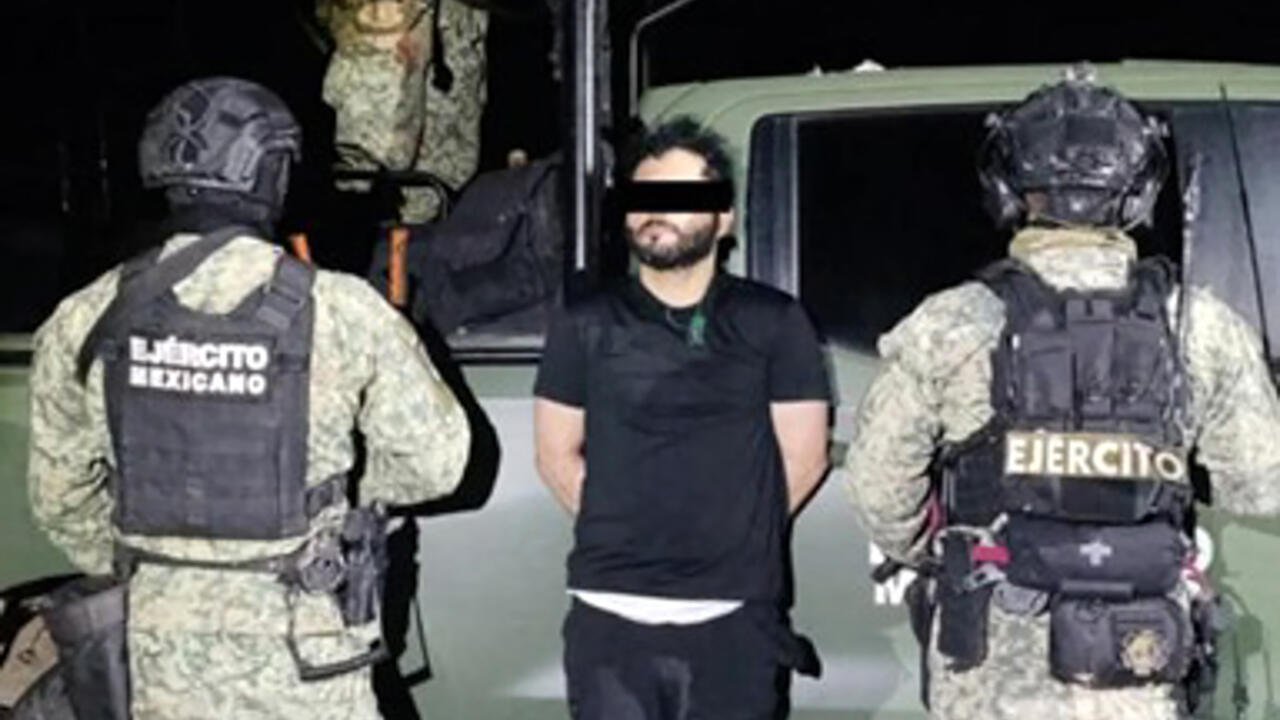
Mexican authorities have arrested eight suspected members of the criminal organisation led by notorious drug trafficker Fausto Isidro Meza Flores, popularly known as “El Chapo Isidro”, following deadly violence triggered by his capture in Sinaloa State.
The arrests came as security forces continued operations across northwestern Mexico after Meza Flores was detained during a major military operation in Guasave on Friday, November 20.
Mexico’s Defence Ministry said the eight suspects were arrested during a security patrol after troops came under fire from members of a criminal group linked to the captured drug trafficker. One of those arrested was a minor.
According to the ministry, the suspects were allegedly involved in establishing roadblocks during the violence that followed the operation on November 20.
Security forces also recovered several high-calibre firearms and six vehicles, including two fitted with improvised armour and turrets designed to mount machine guns.
The arrests represent a further phase of the government’s security response following the operation against Meza Flores, whose capture triggered armed clashes, burning vehicles and roadblocks across parts of Sinaloa.
Mexico’s Defence Secretary, Ricardo Trevilla, said on Monday that 16 suspected members of the criminal organisation had been killed in clashes since the operation began, while four soldiers also lost their lives. The combined death toll from the confrontations therefore reached 20.
The violence initially erupted around Guasave after Mexican special forces moved against Meza Flores and other senior members of his organisation. Residents reported hearing sustained gunfire as armed groups mounted resistance against security forces.
Videos circulating on social media showed burning trucks, blocked roads and civilians fleeing gunfire. Businesses temporarily shut down in affected areas as residents sought shelter.
Mexican authorities said security forces subsequently removed 21 roadblocks and recovered dozens of vehicles used during the unrest. The military maintained its deployment across the state to protect residents and prevent further attacks.
Meza Flores, 44, was captured alongside two senior associates during the operation. They were identified by Mexican authorities as Germán N., known as “Serafín”, who was described as the organisation’s second-in-command, and José N., its alleged financial operator.
The three men were transferred to Mexico City following their arrest.
Known as El Chapo Isidro, Meza Flores was among the Federal Bureau of Investigation’s 10 Most Wanted Fugitives. The United States had offered a reward of up to $5 million for information leading to his arrest.
US authorities accused his organisation of trafficking heroin, methamphetamine, cocaine and marijuana into the United States over more than two decades. He also faced criminal charges in Mexico and the United States.
His organisation was associated with the remnants of the Beltrán Leyva criminal network and had links to one of the rival factions operating within the wider Sinaloa Cartel.
The operation involved Mexican special forces and intelligence cooperation with the United States. US Ambassador to Mexico Ronald Johnson praised the intelligence-sharing arrangement, saying it helped make the operation possible.
US Attorney General Todd Blanche also confirmed that the capture was supported by a coordinated interagency effort involving the US Homeland Security Task Force.
Mexican President Claudia Sheinbaum subsequently clarified that American personnel did not participate directly in the ground operation. She said the United States provided intelligence support, including information gathered through surveillance activities, while the arrest itself was carried out by Mexican forces.
The clarification came amid sensitivities over Mexico’s national sovereignty and repeated calls by US President Donald Trump for stronger action against drug cartels operating across the border.
Meanwhile, the United States has formally requested Meza Flores’s extradition to face charges there. Mexican authorities have not announced a final decision on the request.
The capture comes amid an intensified campaign by the Mexican government against major organised crime figures. In February 2026, the killing of another prominent cartel leader, Nemesio Oseguera Cervantes, popularly known as El Mencho, also triggered widespread violence and retaliatory attacks.
Security analysts have warned that removing senior cartel figures does not necessarily dismantle their organisations. Such operations can create power struggles among remaining commanders, potentially triggering further violence as rival groups compete for control of territory and drug-trafficking routes.
For residents of Sinaloa, the latest operation has renewed concerns about the impact of cartel conflicts on everyday life, with authorities maintaining security deployments as investigations and arrests continue.