


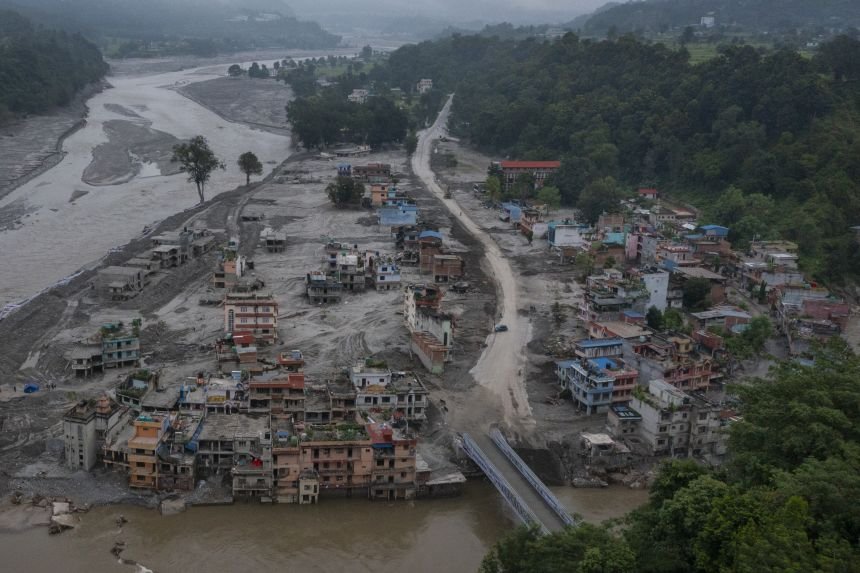
India has announced a $1.62 billion economic assistance package for Nepal to support reconstruction and long-term development following devastating floods that killed about 1,500 people and left more than 5,200 missing.
Indian Prime Minister Narendra Modi announced the package on Monday, November 23, after meeting Nepalese Prime Minister Balendra Shah in New Delhi during the latter’s two-day official visit.
The assistance, valued at 240 billion Nepalese rupees, is intended to help Nepal rebuild communities, restore damaged infrastructure and support families whose homes and livelihoods were destroyed by the August floods.
Speaking at a joint press briefing with Shah, Modi said the package would give fresh momentum to Nepal’s reconstruction and long-term development.
He also expressed India’s condolences over the loss of lives and reaffirmed New Delhi’s commitment to helping its neighbour recover from the disaster.
According to Reuters, the package comprises a $377 million grant for post-disaster reconstruction and infrastructure development, alongside a $1.24 billion line of credit for energy projects. Details of the specific projects and financing arrangements are expected to be agreed through further consultations between the two countries.
The August 26 disaster was triggered by a glacier collapse near Nepal’s border with China, sending massive volumes of mud, rocks and floodwater into the Trishuli River.
The resulting floods and landslides swept through communities, destroyed homes and farms, and damaged roads, bridges, power lines and hydropower facilities.
Nepalese authorities estimate that reconstruction will require approximately $4.78 billion, reflecting the scale of the destruction across the Himalayan country.
The disaster also affected Nepal’s energy sector, damaging more than a dozen hydropower projects and reducing the country’s electricity generation capacity by about 10 per cent. The disruption affected electricity exports and added pressure to an economy heavily dependent on infrastructure and cross-border trade.
Shah welcomed India’s assistance, thanking the country for its support during natural disasters and other difficult periods.
He also invited Indian investors to participate in Nepal’s economic development, signalling his government’s interest in strengthening investment and commercial cooperation between the neighbouring countries.
Monday’s announcement formed part of a broader effort by both governments to deepen economic and diplomatic relations. During the visit, Modi and Shah also inaugurated several infrastructure projects, including a hydropower facility, an oil storage terminal, an expanded petroleum pipeline and a cross-border railway service.
The two leaders also signed agreements covering education and research, satellite communications and sustainable urban development.
Shah’s visit marks his first bilateral trip to India since becoming prime minister in March 2026. His administration came to power following a youth-led uprising in September 2025 that forced former Prime Minister K.P. Sharma Oli from office.
India remains Nepal’s largest trading partner and an important source of fuel, essential supplies, investment and development assistance. The two countries share an open border and longstanding cultural, economic and social ties.
However, Nepal has also sought to balance its relationship with India against growing economic and infrastructure engagement with China, which has invested in roads, airports and hydropower projects across the Himalayan nation.
The latest assistance package therefore carries significance beyond immediate disaster recovery, reinforcing India’s role as a major development partner at a time when Nepal faces substantial reconstruction needs.
The United Nations Fund for Responding to Loss and Damage has separately pledged approximately $20 million to support Nepal’s recovery. The amount is considerably smaller than the reconstruction assistance announced by India.
The scale of the disaster has also renewed international attention on the vulnerability of mountainous communities to climate-related hazards. Nepal contributes relatively little to global greenhouse gas emissions but faces significant exposure to floods, landslides and other climate-related risks.
The disaster has highlighted the importance of investing in resilient infrastructure, early-warning systems and emergency preparedness. In Nigeria, similar concerns have informed government relief and recovery interventions, including the National Emergency Management Agency’s recent distribution of relief materials to flood and windstorm victims in Kogi State.
For Nepal, the immediate challenge will be translating the announced assistance into completed reconstruction projects and meaningful support for affected households.
Although India’s package provides a significant financial commitment, the full impact will depend on how quickly the funds are deployed, the projects selected and the effectiveness of implementation.
The agreement marks an important step in Nepal’s recovery following the August floods, while strengthening cooperation between New Delhi and Kathmandu on infrastructure, energy and long-term development.