


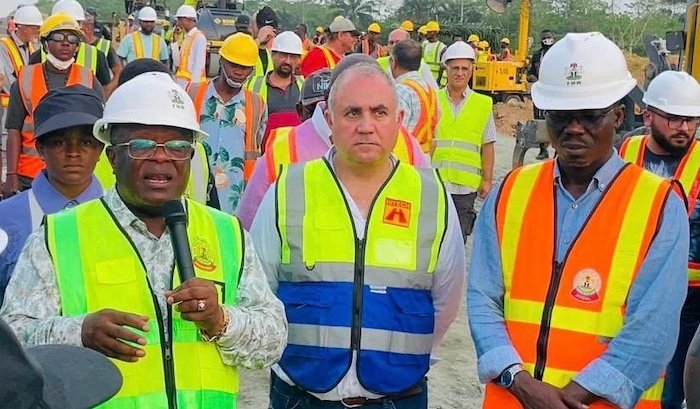
Minister of Works David Umahi has defended the Federal Government’s borrowing programme, insisting that funds obtained through external loans are being invested in infrastructure and other projects expected to generate economic returns for Nigeria.
Umahi made the remarks on Sunday, November 22, while inspecting bridges and other sections of the ongoing Lagos-Calabar Coastal Highway project in Lagos State.
The minister said the government was not using borrowed funds solely for road construction, explaining that its broader investment plans also included rental housing, tourism facilities, factories and other commercial developments along the highway corridor.
According to him, the projects are intended to improve transportation, stimulate economic activities and create opportunities for the government to recover its investments.
“When you ask about the monies which are being borrowed, they are being used for infrastructure. They are being used for investment in infrastructure,” Umahi said during the inspection.
He disclosed that investors had already expressed interest in arrangements that could allow them to recover the government’s expenditure on the coastal highway in exchange for operating tolling facilities.
However, he said the government was still considering the proposals and exploring additional facilities that could improve the commercial potential of the road.
Umahi explained that the Federal Government was considering the installation of closed-circuit television cameras, the development of rental accommodation and the acquisition of land for tourism facilities, factories and other businesses along the route.
He described the projects as profit-driven investments for Nigeria, arguing that the infrastructure would create opportunities for revenue generation beyond conventional road tolling.
During the inspection, the minister also highlighted progress on sections of the Lagos-Calabar Coastal Highway. He said Section One had been completed about six months earlier, while Section Two, covering approximately 53 kilometres, had also been completed.
He listed some of the infrastructure features incorporated into the completed sections, including solar-powered streetlights, underground drainage systems and pedestrian walkways.
Umahi claimed that more than 200 kilometres of the coastal highway had been delivered within two and a half years, describing the pace of construction as remarkable.
He expressed satisfaction with the project’s progress and praised President Bola Tinubu for supporting the construction of the coastal route, which is designed to connect communities along Nigeria’s coastline from Lagos to Calabar.
The minister also discussed other major road projects being undertaken by the administration, including the 1,068-kilometre Sokoto-Badagry Superhighway, which he said was approximately 30 per cent completed, and the 465-kilometre Trans-Sahara Road, which he put at about 20 per cent completion.
He added that construction was progressing on the Akwanga-Jos-Bauchi-Gombe-Biu-Maiduguri Road.
Umahi said the projects formed part of the administration’s broader infrastructure investment programme, which he maintained would improve connectivity and support economic development across the country.
The minister’s defence of government borrowing comes as President Tinubu has asked the House of Representatives to authorise the Federal Government to access $7.71 billion, equivalent to approximately ₦10.79 trillion, in external loans already captured in the 2026 Appropriation Act.
The request was conveyed in a letter addressed to the Speaker of the House of Representatives, Tajudeen Abbas, and read during plenary last Wednesday.
Tinubu said the proposed external borrowing would help finance part of the Federal Government’s budget deficit and support projects across critical sectors, including defence, transportation, agriculture, power, education and healthcare.
Eurobond issuance is expected to be one of the major financing options for the proposed borrowing.
The request has renewed attention on Nigeria’s borrowing strategy, particularly the government’s ability to ensure that loans translate into productive investments capable of supporting economic growth and generating sufficient returns to meet future repayment obligations.
Former President Olusegun Obasanjo has previously criticised the administration’s borrowing policy, warning that excessive debt could place a long-term burden on future generations. TheDailyNewsHub examined the debate in its report on Obasanjo’s criticism of Tinubu’s borrowing policy and his warning about the impact of debt on future generations.
The proposed $7.71 billion external borrowing also forms part of the wider debate over public financing and infrastructure development. In an earlier report, TheDailyNewsHub detailed Tinubu’s request for legislative approval to access ₦10.79 trillion in external loans for the 2026 budget.
While Umahi has maintained that borrowed funds are being channelled into infrastructure and investments, the long-term benefits will depend on effective project delivery, transparent financing arrangements, proper maintenance and the ability of completed projects to generate the expected economic returns.
The proposed involvement of private investors in tolling and other commercial facilities along the Lagos-Calabar Coastal Highway could provide an additional revenue model for the project. However, the terms of any agreement, including investment recovery arrangements and operating responsibilities, have yet to be fully disclosed.
The minister’s comments therefore place renewed focus on the government’s infrastructure strategy and its efforts to justify borrowing through projects expected to improve transportation, attract investment and expand Nigeria’s productive capacity.