


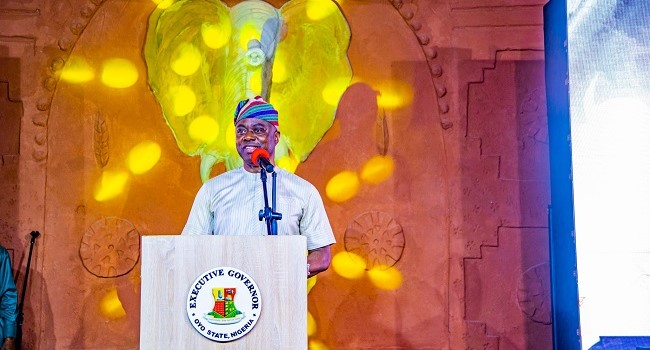
Oyo State Governor and Allied Peoples Movement (APM) presidential candidate Seyi Makinde has outlined his proposed “Reset Nigeria” agenda, promising reforms to the economy, education, security and the country’s political structure if elected president in 2027.
Makinde presented the proposals on Tuesday, September 22, 2026, during an APM North-West town meeting in Katsina, where he also pledged to comply with constitutional requirements governing the transfer of presidential powers when the president is unavailable.
Makinde said he would transmit power to the Vice President whenever he was away from office, including during vacation, and pledged to follow the Constitution “to the letter”. He cited Section 145 of the 1999 Constitution, which provides for a written declaration to the Senate President and Speaker of the House of Representatives when a president proceeds on vacation or is otherwise unable to perform the functions of office.
Economic reforms
Under his proposed economic reset, Makinde said Nigeria needs an economy capable of sustaining intensive production and operating around the clock.
He argued that the country’s natural resources alone would not be sufficient to deliver broad economic prosperity without investment in skills, knowledge and productive capacity.
His campaign platform identifies economic expansion, jobs, enterprise, industry and agriculture among the objectives of its proposed economic reforms.
Makinde has also previously called for changes to Nigeria’s petroleum pricing framework and said the country’s oil resources should provide measurable benefits to Nigerians.
Education and skills
Makinde also proposed reforms to the education sector, including the development of more reliable data on the number of out-of-school children.
He said his administration would seek to establish the scale of the problem and develop measures for returning children to school.
His broader Reset Nigeria platform lists improved learning outcomes, technical skills, teacher development and digital access among its proposed education priorities.
Proposed restructuring of mining responsibilities
On natural resources, Makinde called for mining to be removed from the Exclusive Legislative List and for greater responsibility to be transferred to the states, with the Federal Government retaining an oversight role.
He argued that states would be better positioned to manage mining activities under such an arrangement.
The proposal forms part of his wider argument for restructuring responsibilities between the federal and subnational levels of government.
Security reforms
Security also featured prominently in Makinde’s proposals.
He argued for changes to Nigeria’s security architecture and questioned approaches that focus primarily on illegal miners while paying insufficient attention to those who purchase or benefit from illegally mined resources.
His campaign platform lists intelligence, professional security institutions, community safety and accountable coordination among its proposed security priorities.
Makinde’s proposed security reforms build on commitments he made when he emerged as the APM’s presidential candidate in May, when he called for reforms to the national security architecture and greater decentralisation of security management.
Governance and constitutional compliance
The governor placed constitutional compliance at the centre of his leadership pledge, particularly regarding presidential absence.
He said his practice would be to formally transmit power to the Vice President whenever he was unavailable, including when travelling on vacation.
The comments come amid a recent national debate over the constitutional procedure for presidential absence, following President Bola Tinubu’s extended stay outside Nigeria. Makinde’s position was presented as a commitment he would make if elected president in 2027.
Eight proposed national missions
Makinde’s official Reset Nigeria platform currently sets out eight national missions covering the economy, security, education, healthcare, infrastructure, governance, national unity and public trust.
The platform proposes, among other things, stronger public institutions, improved public-service delivery, infrastructure investment, expanded healthcare access and greater transparency in government.
The governor has been developing the Reset Nigeria proposition since the beginning of September. His campaign website describes it as a plan to rebuild systems and institutions, while his September 17 newsletter presented education, the economy, security and socio-political development as four central pillars of the agenda.
Makinde became the APM’s presidential candidate in May 2026 and is expected to campaign on the Reset Nigeria platform ahead of the 2027 presidential election.
The proposals remain campaign commitments rather than enacted government policies, and their implementation would depend on the outcome of the 2027 election as well as legislative and constitutional processes where required.