


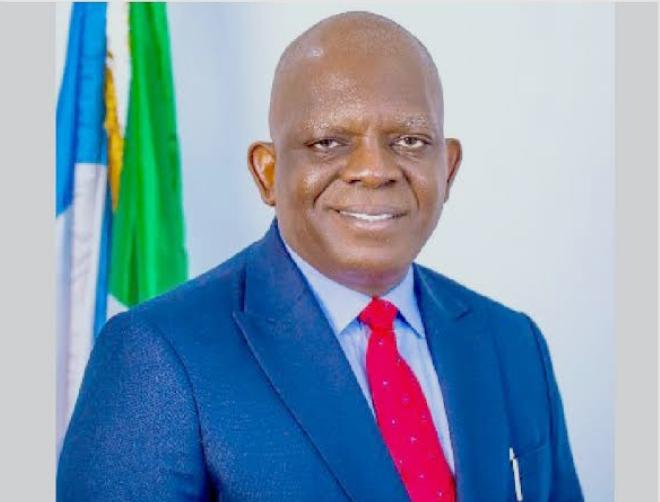
The newly established Nigeria Ports Economic Regulatory Agency, NPERA, has been positioned to play a pivotal role in Nigeria’s ambition of building a $1 trillion economy, with its Director-General/Chief Executive Officer, Dr. Pius Akutah, MON, urging staff to embrace professionalism, accountability and a results-driven work culture.
Akutah gave the charge during a town hall meeting with staff at the agency’s headquarters in Lagos, where he described the transition from the Nigerian Shippers’ Council, NSC, to NPERA as a major institutional transformation requiring a corresponding change in mindset and approach to work.
The meeting was one of the first major engagements between the new management and staff following President Bola Ahmed Tinubu’s assent to the Nigeria Ports Economic Regulatory Agency Act, 2026, which formally established NPERA as Nigeria’s statutory economic regulator for the ports.
Akutah said the new legislation had provided the agency with a stronger legal foundation and broader powers to promote efficiency, transparency, fair competition and competitiveness in the Nigerian port industry.
He stressed that the transition was not merely a change of name or institutional identity, but a fundamental transformation that must be reflected in the conduct and performance of personnel.
“NPERA’s effectiveness would ultimately be measured by the quality of services delivered to port users, the predictability of the regulatory environment and the agency’s contribution to making Nigerian ports more competitive,” he said.
The Director-General linked the new regulatory framework to the Federal Government’s ambition of building a $1 trillion economy, noting that an efficient and business-friendly port system was critical to expanding trade, attracting investment and unlocking the economic potential of Nigeria’s maritime sector.
He said NPERA would work towards creating a regulatory environment where shipping lines, terminal operators, importers, exporters, freight forwarders and other port users could operate with greater certainty.
Akutah commended President Tinubu for assenting to the legislation, describing the Act as the long-awaited statutory framework for transforming port economic regulation into a full-fledged institutional mandate.
He also acknowledged the role of the Minister of Marine and Blue Economy, Adegboyega Oyetola, and the National Assembly for facilitating the passage of the law.
According to him, under the NPERA Act, the agency is empowered to regulate port tariffs and charges, enforce service standards, promote fair competition, facilitate trade and provide mechanisms for resolving commercial disputes within the ports industry.
He added that the agency would also strengthen protection for port users and promote a more transparent and predictable business environment capable of attracting investment and improving Nigeria’s position in regional and global maritime trade.
Akutah assured stakeholders that NPERA would work closely with sister agencies, particularly the Nigerian Ports Authority, NPA, to deepen ongoing reforms and improve service delivery.
He clarified that the emergence of NPERA was not intended to create institutional rivalry, but to provide a clearer separation of responsibilities within the maritime sector.
He consequently charged staff to ensure that the transformation from the Shippers’ Council to NPERA was reflected not only in the agency’s expanded statutory powers, but also in professionalism, efficiency and a stronger service-oriented approach to their responsibilities.