


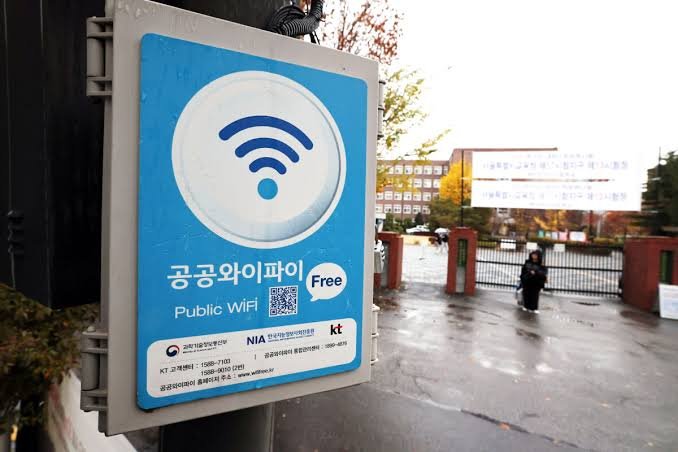
South Korea has temporarily shut down public and telecommunications-operated Wi-Fi services within 100 metres of nationwide university entrance examination centres as authorities intensify efforts to prevent artificial intelligence-assisted cheating.
The suspension began at 6 p.m. on Wednesday, November 18, and is scheduled to remain in place until 6 p.m. Thursday, November 19, covering the period of the 2027 academic year College Scholastic Ability Test (CSAT), known locally as Suneung.
The country’s three major telecommunications operators — SK Telecom, KT and LG Uplus — are implementing the measure following a government request. The shutdown covers Wi-Fi networks inside examination schools and public hotspots located within the designated 100-metre radius.
The measure comes amid growing concern over the use of artificial intelligence and sophisticated electronic devices to cheat in examinations. Authorities are particularly concerned that candidates could use smart glasses, miniature cameras or concealed devices to photograph examination questions, transmit them to people outside the examination centres and receive AI-generated answers.
The government’s decision follows a recent cheating scandal involving a top scorer in South Korea’s national tax accountant examination, who admitted using a miniature camera, smartphone and generative AI to obtain answers during the test.
The incident prompted Prime Minister Han Seong-sook to convene an emergency meeting involving relevant ministries and order stronger measures to protect the integrity of national examinations. The government subsequently announced tighter device checks, additional examination supervision and stricter penalties for confirmed cheating.
Telecommunications companies and public Wi-Fi operators are disabling networks using different methods depending on the equipment involved. In many cases, operators are stopping the broadcast of network names, known as service set identifiers, or SSIDs. Some systems may also have their internet connections disconnected, while older equipment that cannot be managed remotely may be switched off manually.
The Wi-Fi suspension is intended to make it more difficult for candidates to transmit examination materials to external sources using connected devices. However, authorities acknowledge that the measure cannot completely eliminate wireless communication, as privately installed routers and mobile-phone tethering cannot be universally disabled.
The government has also introduced additional security measures for the examination, including requiring candidates to surrender prohibited smart devices and conducting checks for items such as smart glasses and concealed electronic equipment.
The College Scholastic Ability Test is one of South Korea’s most consequential examinations, with results playing a major role in determining university admissions. The annual examination is highly competitive, and students, families and educational institutions place considerable importance on its outcome.
The growing use of artificial intelligence has raised new challenges for examination authorities worldwide, particularly as smart glasses, miniature cameras and connected devices become increasingly sophisticated and difficult to detect.
TheDailyNewsHub previously reported on South Korea’s plans to introduce criminal penalties and tougher examination bans for students caught using AI-powered smart glasses to cheat, highlighting the country’s growing efforts to respond to technology-assisted examination fraud.
The temporary Wi-Fi suspension forms part of a broader strategy to strengthen examination security and maintain public confidence in the fairness of South Korea’s national testing system. Authorities are expected to continue reviewing security measures as artificial intelligence creates new opportunities and challenges for examination administration.