


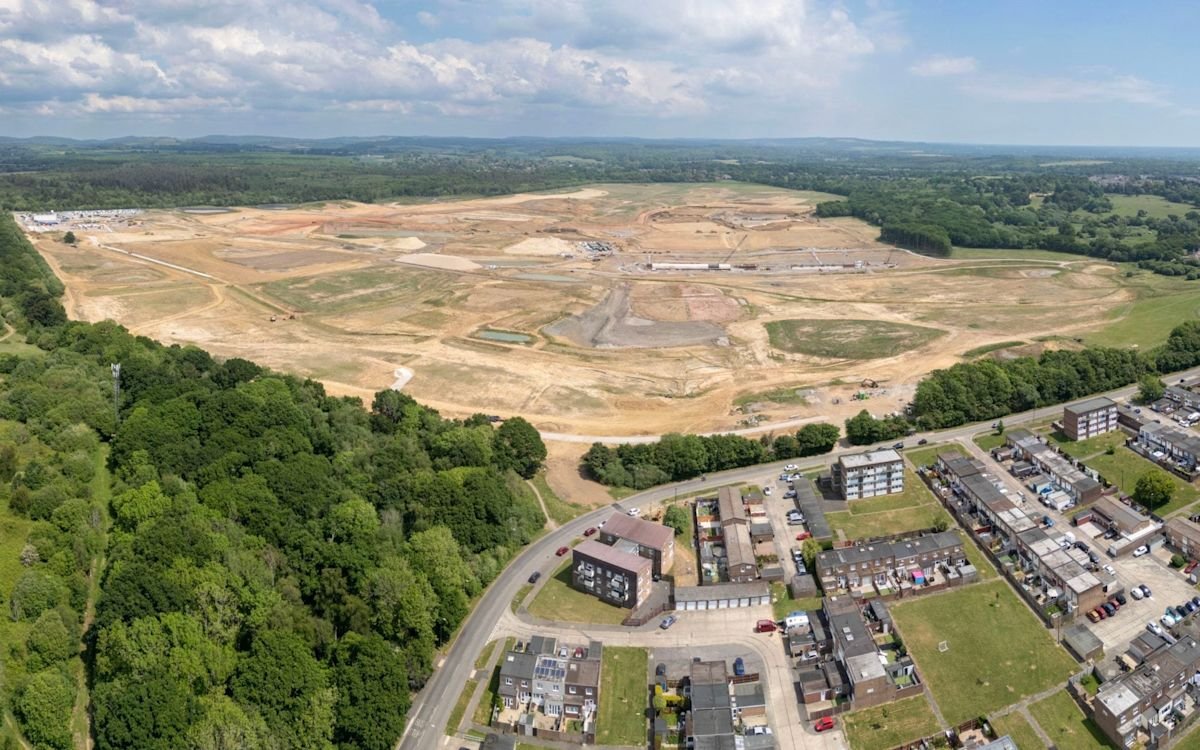
The United Kingdom is accelerating efforts to strengthen its water supplies through the construction of a major new reservoir in southern England, as persistent drought conditions and increasingly unpredictable weather raise concerns about long-term water security.
The £800 million Havant Thicket Reservoir project, located near Portsmouth in Hampshire, is expected to become Britain’s first major new reservoir in more than three decades.
Construction is underway, with heavy machinery excavating the site as the country faces growing pressure to improve its ability to store water during wetter periods for use during increasingly dry summers.
Although Britain is traditionally associated with frequent rainfall, the country experienced record-breaking heat during the summer of 2026. Despite the return of rain in autumn, several parts of England remain affected by drought.
According to the Environment Agency, almost all of England remained in drought by mid-November, with some areas experiencing severe drought. Reservoir storage stood at 59.1 per cent on November 10, approximately 19.3 percentage points below the average for that time of year.
Climate scientist Hannah Cloke of the University of Reading told AFP that the country was facing increasing challenges with water security.
She said Britain needed to reconsider how it stored water, warning that the problem was likely to become more serious.
The Havant Thicket project is designed to address some of these challenges by providing additional storage capacity. When completed, the reservoir is expected to hold up to 8.7 billion litres of water, helping secure supplies for hundreds of thousands of people.
Portsmouth Water Chief Executive Bob Taylor said the industry was increasingly recognising the importance of storing water during periods of surplus rainfall.
He explained that the challenge was not simply the total amount of rainfall received annually, but also when the rain falls. Wetter winters and increasingly dry summers make storage infrastructure essential for maintaining reliable supplies throughout the year.
The reservoir will be supplied partly through surplus winter water from a nearby spring already used by Portsmouth Water.
The project forms part of a wider government strategy to strengthen water infrastructure following years of underinvestment and repeated drought conditions.
The UK Government has plans for nine additional major reservoirs by 2050, alongside measures to develop desalination facilities and improve water transfers between regions. Together, the planned reservoirs could provide an additional 670 million litres of water per day.
The government’s long-term plans also include reducing water leakage, improving efficiency and encouraging households and businesses to use water more responsibly.
The challenge is significant. England’s National Framework for Water Resources warns that the country could face a daily public water supply deficit of five billion litres by 2055 if sufficient action is not taken.
Growing population numbers and the expansion of water-intensive industries, including data centres, are expected to increase demand.
The government has also introduced financial support for farmers affected by drought, including up to £15 million in grants for on-farm water storage projects.
In October, the government declared severe drought in parts of Cornwall, Devon, Dorset, Somerset, East Sussex and West Sussex, prompting water companies to strengthen measures to protect public supplies.
The construction of Havant Thicket therefore represents an important part of Britain’s response to the changing climate, although experts have stressed that building reservoirs alone will not resolve the country’s water challenges.
Reducing leakage, improving water recycling, managing demand and protecting natural water sources will also be necessary to ensure long-term resilience.
As Britain experiences more frequent periods of extreme heat and prolonged dry weather, the country’s ability to capture and store rainfall is becoming an increasingly important part of its environmental and infrastructure planning.