


By TheDailyNewsHub Reporter
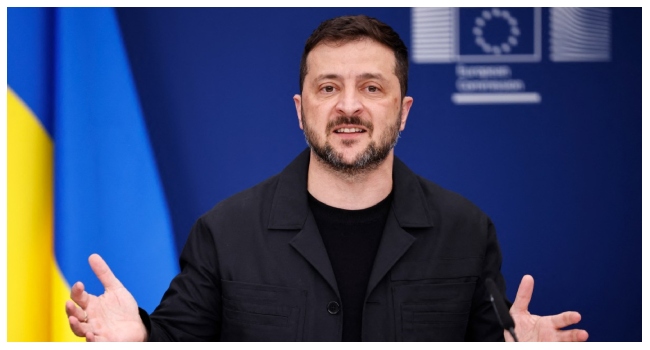
Ukrainian President Volodymyr Zelensky has disclosed that United States negotiators raised the possibility of Ukraine withdrawing from the eastern Donbas region in exchange for membership of the North Atlantic Treaty Organisation (NATO), introducing a new dimension to ongoing efforts to negotiate an end to Russia’s war against Ukraine.
Zelensky made the disclosure in remarks to journalists released on Saturday, following a week of diplomatic engagements in Denmark and Ireland and two days of US-brokered negotiations involving Ukraine and Russia in Abu Dhabi, United Arab Emirates.
According to the Ukrainian president, American representatives raised the question of whether Ukraine would withdraw from Donbas if it were admitted into NATO. He described it as the first time the issue had been raised in that form during the negotiations.
“The Americans raised a question: ‘What if Ukraine joins NATO? Would Ukraine withdraw from Donbas?'” Zelensky said.
The comments suggest that territorial concessions and security guarantees remain central to discussions about a possible settlement, although the United States has not publicly confirmed that a formal proposal has been made.
Zelensky reiterated that Ukraine was not prepared to surrender its territory. However, he indicated that any comprehensive security arrangement involving NATO and European Union guarantees, a sufficiently strong Ukrainian military and financial support for reconstruction would require consultation with the Ukrainian population.
He said he had no right to make such a decision independently and would put the question to Ukrainian citizens if the necessary guarantees were clearly established by Western partners.
The Donbas region, comprising Donetsk and Luhansk, has been at the centre of the conflict since Russia’s invasion of Ukraine in February 2022. Moscow has sought control over the area, while Ukrainian forces continue to defend territories that remain under Kyiv’s administration.
Russia has also consistently opposed Ukraine’s potential NATO membership, describing the alliance’s eastward expansion as a security threat. Moscow has cited NATO-related concerns among its justifications for the invasion, claims rejected by Ukraine and its Western allies.
The latest discussions in Abu Dhabi ended without a major breakthrough. However, Zelensky said the parties agreed that European representatives should participate in future negotiations, following concerns among European governments about their limited involvement in earlier discussions.
US envoys Steve Witkoff and Jared Kushner participated in the negotiations and subsequently held separate meetings with Russian President Vladimir Putin and Zelensky.
The Ukrainian president also disclosed that Russia had rejected a proposal for a ceasefire covering attacks on energy infrastructure. Such an arrangement would have sought to prevent both sides from striking power facilities and other energy-related targets, particularly as winter approaches.
Zelensky said Russian representatives indicated that they did not have the authority to agree to such a measure and that the issue would need to be addressed directly with Putin.
He also said Russia was concentrating significant military resources on its winter campaign, warning that the coming months could bring further pressure on Ukrainian cities and infrastructure.
“They are betting everything on this winter,” he said.
The Ukrainian leader warned that Moscow’s demands for a broader restructuring of Europe’s security arrangements were dangerous and could create conditions for further conflict.
He maintained that discussions about the future security framework of Europe should not take precedence over ending the war in Ukraine.
The negotiations also addressed humanitarian issues, including prisoner exchanges. Zelensky said an exchange involving more than 1,000 people had been agreed in principle, although the final arrangements and numbers were still being worked out.
Another point of disagreement concerned the eastern Ukrainian city of Kostiantynivka in the Donetsk region. Zelensky rejected Putin’s suggestion of a humanitarian arrangement involving the city, arguing that a Ukrainian withdrawal could allow Russian forces to occupy it.
The latest diplomatic developments come as European leaders seek a more direct role in determining the terms of any eventual peace agreement. Leaders meeting in Dublin agreed that Britain, France, Germany, Italy and Poland, alongside European Union institutions, should represent Europe in future discussions.
The growing involvement of European governments reflects concerns that any agreement affecting Ukraine’s borders and long-term security could have consequences for the wider continent.
TheDailyNewsHub previously reported on European efforts to reduce dependence on foreign satellite communications infrastructure following concerns about systems used by Ukrainian forces. The discussions highlighted how Ukraine’s defence and security arrangements are closely connected to wider European strategic interests.
For now, the proposed link between NATO membership and a possible Ukrainian withdrawal from Donbas remains a question raised by US negotiators, rather than an agreed peace arrangement. Kyiv has maintained that it will not surrender territory, while the conditions for any security guarantees and the position of Moscow remain unresolved.
The next phase of negotiations is expected to test whether the United States, Ukraine, Russia and European governments can agree on a framework that addresses territorial disputes, security guarantees and the wider conflict.