


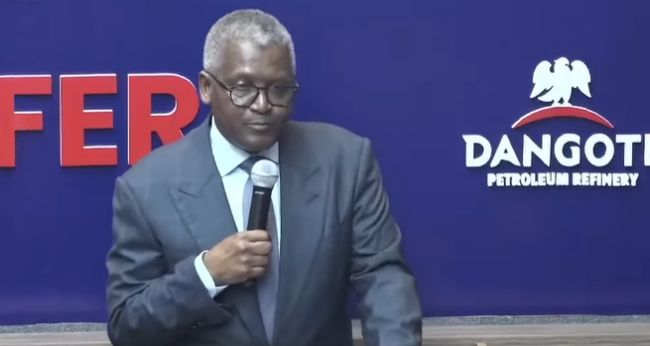
Nigerian businessman and Dangote Group President Aliko Dangote has projected that most African countries will become largely self-sufficient in refined petroleum products by 2030 as investment in refining capacity expands across the continent.
Dangote made the projection on Tuesday, September 29, 2026, in Nairobi, Kenya, where he was speaking ahead of the groundbreaking of a planned $16 billion oil refinery in Lamu. The proposed facility is expected to have a refining capacity of 700,000 barrels per day and is scheduled to begin construction following its groundbreaking ceremony.
Asked when Africa could stop relying on fuel imports from outside the continent, Dangote said he expected the majority of African countries to achieve self-sufficiency by 2030. He stressed that the key issue was not necessarily where crude oil was refined within Africa, but that refining and the production of finished petroleum products should increasingly take place on the continent.
Dangote said Africa’s continued export of raw materials and subsequent importation of finished products remained a major economic challenge. He argued that processing resources locally would allow African countries to retain more value from their natural resources and strengthen industrial capacity.
The comments came as Dangote prepares to expand his refining interests beyond Nigeria. The planned Lamu refinery is designed to process 700,000 barrels of crude oil per day and is expected to take about 30 months to construct, according to reports on the project.
The Kenyan project is expected to serve markets in East Africa and could become an important part of the region’s petroleum supply infrastructure. However, questions remain about the refinery’s future crude supply because Kenya’s domestic oil production is expected to be significantly below the facility’s planned processing capacity. Kenya’s current production projections indicate that the refinery would need to rely heavily on crude from outside the country.
Dangote’s projection also comes as refining capacity in Nigeria continues to expand. The Dangote Petroleum Refinery in Lagos currently has a crude distillation capacity of about 700,000 barrels per day, with the company pursuing an expansion that would take the complex to about 1.4 million barrels per day.
Nigeria’s downstream sector has also been moving toward greater domestic processing. The Nigerian Midstream and Downstream Petroleum Regulatory Authority has said the country’s domestic refining capacity has grown to about 1.125 million barrels per day and that the government is working to ensure more locally produced crude is supplied to domestic refineries.
Beyond Nigeria and Kenya, Dangote has framed the expansion of refining capacity as part of a wider push for greater intra-African trade and industrialisation. His group has previously outlined plans for major investments across Africa, while the company’s refining operations are intended to supply both domestic and regional markets.
The extent to which Africa can achieve the level of fuel self-sufficiency projected by Dangote by 2030 will depend on how quickly new refineries come on stream, access to crude feedstock, financing, infrastructure, domestic fuel demand and the ability of existing facilities to operate reliably.
For now, Dangote’s 2030 projection represents his assessment of where Africa’s refining industry could be within the next four years, rather than a confirmed continent-wide outcome.
[…] The debate comes as Nigeria continues to expand domestic refining capacity. The Dangote Petroleum Refinery is central to discussions about local production and the country’s ability to reduce dependence on imported petroleum products. TheDailyNewsHub previously reported on Dangote’s projection that Africa could become largely self-sufficient in fuel by 2030. […]