


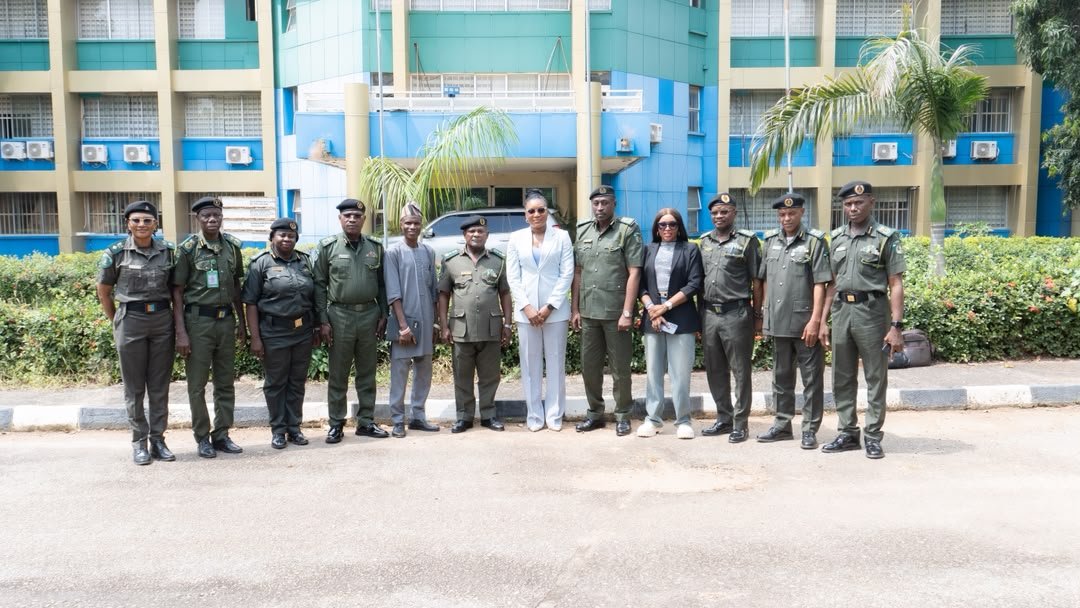
The National Park Service (NPS) has called for stronger collaboration with environmental journalists to expose illegal activities in Nigeria’s forests and protected areas, as insecurity, illegal mining and wildlife trafficking continue to threaten conservation efforts.
The call was made by the Conservator-General of the National Park Service, Mr. Ibrahim Goni, when members of the Environmental Media Correspondents Association of Nigeria (EMCAN) paid a courtesy visit to the Service’s headquarters in Abuja.
This was disclosed in a statement issued by the Secretary of EMCAN, Samuel Adeyinka.
Mr. Goni described environmental journalists as strategic partners in the campaign to protect Nigeria’s natural resources and wildlife, stressing that increased media attention would bring conservation challenges to the forefront of public discourse and spur action by relevant authorities.
“We are comfortable to have you as partners. We are also comfortable to collaborate with you so that our issues can be given widespread visibility,” he said.
He identified illegal mining, illegal hunting, timber exploitation, banditry and kidnapping as major threats to effective management of national parks.
According to him, the interconnected nature of Nigeria’s forests makes it difficult to isolate national parks from criminal activities in surrounding forest reserves. He explained that even when criminal elements are dislodged from a national park, adjoining forests provide alternative hideouts.
Goni commended the Armed Forces and other security agencies for their efforts in tackling insecurity.
The Conservator-General disclosed that the Service, in collaboration with the Nigerian Army, closed two illegal mining sites in Gashaka-Gumti National Park in Taraba and Adamawa States, leading to the closure of extensive mining pits and dislodgement of over 4,000 miners.
He warned that dislodging illegal miners could generate resistance, highlighting the need for alternative livelihoods for affected communities.
He also raised concerns over mining activities in Oyo State, noting that the Service was working with the Ministry of Solid Minerals to address the situation, and cited the arrest of about 17 miners in Rivers State.
Mr. Goni said Nigeria is frequently identified in wildlife trafficking networks because smugglers use the country as a transit route to seaports, moving specimens from neighbouring countries including Chad, Niger and Cameroon.
He disclosed that the Nigeria Customs Service, National Park Service, National Environmental Standards and Regulations Enforcement Agency (NESREA) and the Nigeria Police Force have formed an inter-agency committee to combat trafficking. The committee has carried out raids leading to the seizure of live animals, carcasses and other specimens.
The CG expressed concern over the rate of forest destruction, saying Nigeria is losing close to 300 hectares of forest reserve daily due to illegal logging and hunting, warning that it could accelerate desertification.
He said Nigeria now has 17 national parks, 13 of which are operational, compared to seven before the creation of 10 additional parks during the administration of former President Muhammadu Buhari. The expansion, he said, is intended to restore degraded vegetation and strengthen climate change response.
He urged journalists to also highlight issues of environmental pollution, flooding, erosion and public education on Ebola and wildlife-related diseases, noting that the Federal Ministry of Environment has deployed flood-warning equipment in several parts of the country.
He pledged to consider journalists’ welfare, professional training and conference participation within the Service’s budgetary framework.
Responding, EMCAN Chairman, Mrs. Joycelyn Ellakeche Adah, said the association is committed to bridging the communication gap between environmental agencies and the media.
She said the new leadership, elected about two months ago, identified inadequate engagement as a major challenge affecting effective reporting of the sector.
“As journalists, our job is to report on this sector. In every parastatal, there is an environment correspondent, and the job of that correspondent is to report on the sector,” she said.
Adah noted that although EMCAN has over 35 members, only three or four media organisations regularly cover the National Park Service, limiting visibility of its activities.
She said the association is ready to partner with the Service to publicise its initiatives and educate Nigerians on its mandate.
The meeting ended with resolutions by both bodies to enhance mutual cooperation.