


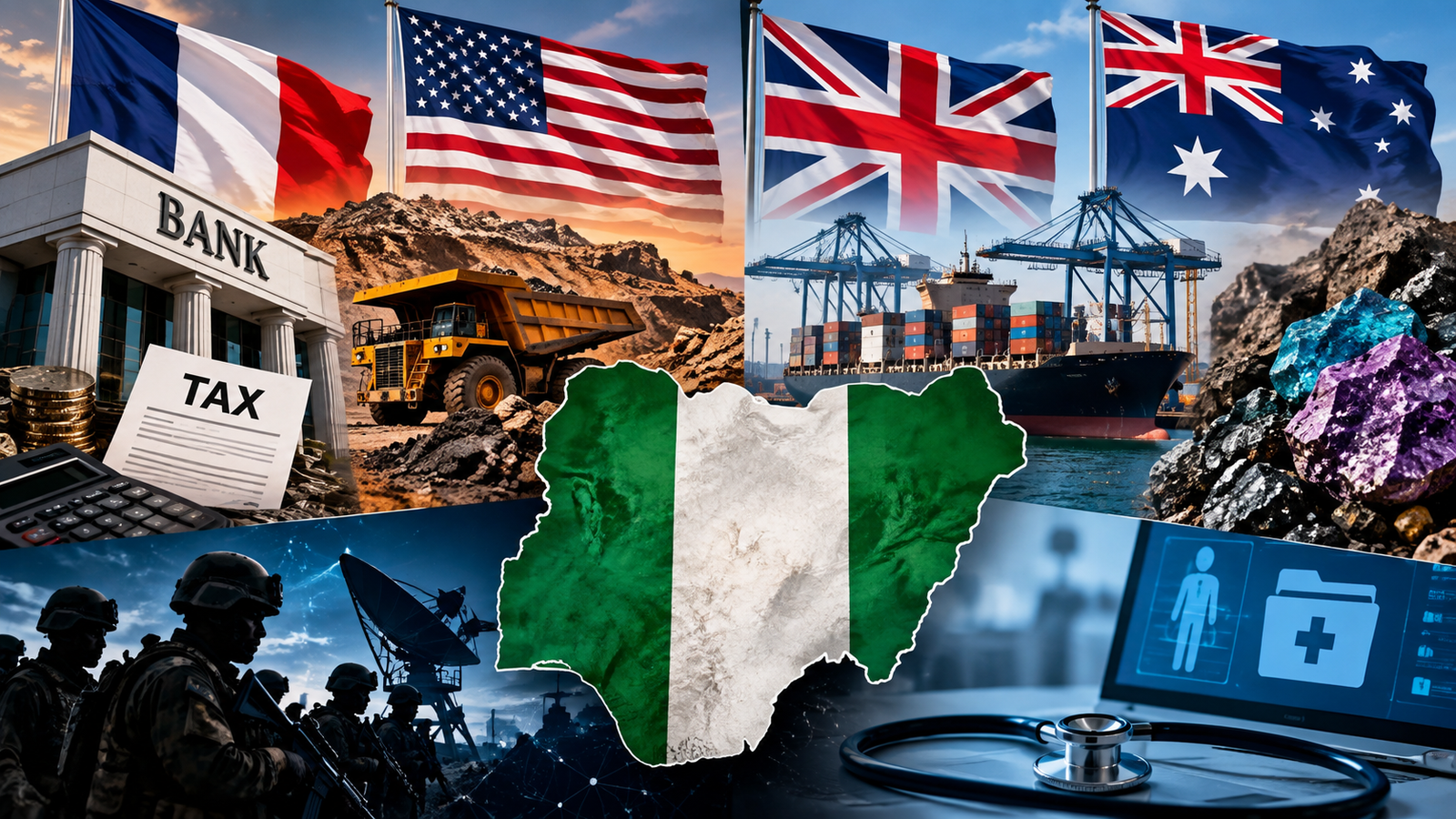
A social media post warning that Nigeria is gradually surrendering control of its banking system, mineral resources, health data and strategic infrastructure to foreign powers has sparked debate online, following a series of international agreements and investment frameworks involving the Federal Government.
The post, circulated on X, lists France, the United States, Britain and Australia as alleged beneficiaries of different Nigerian assets and sectors before asking what would remain of the country to serve its population. It also references Nigeria’s colonial history and the historical exploitation of African resources.
However, a review of recent agreements and official records shows that several of the claims require significant qualification. While Nigeria has entered into partnerships involving foreign investment, financing, technology and technical cooperation, the available evidence does not establish that ownership of the country’s national assets has been transferred wholesale to foreign governments.
What the US-Nigeria mining agreement actually says
One of the developments at the centre of the current debate is Nigeria’s new minerals investment framework with the United States.
On September 24, 2026, Nigeria’s Minister of Solid Minerals Development, Dele Alake, and US Deputy Secretary of State Christopher Landau signed a framework in New York aimed at attracting American investment into Nigeria’s mining sector.
The Nigerian government estimates the country’s mineral resources at about $700 billion. The framework covers geological data and exploration, mineral development and processing, infrastructure and technical capacity. It is intended to provide a basis for business-to-business investment and partnerships across the mineral value chain.
Importantly, the agreement does not itself transfer Nigeria’s $700 billion estimated mineral resource base to the United States. No specific mining projects, participating companies or financing commitments were announced as part of the framework. Alake said the next stage would involve identifying viable projects, mobilising investment and developing commercial partnerships.
The $700 billion figure is not money handed to America
The figure of $700 billion cited in the viral post can also be misleading if interpreted as money or assets that Nigeria has already transferred to the United States.
The amount is an estimate of the potential value of Nigeria’s mineral resources cited by the Federal Government. It is not the value of an investment already made by Washington, nor does the recently signed framework give the US ownership of the entire resource base.
The actual economic question will be how future mining agreements are structured, who receives licences, what companies invest, how royalties and taxes are collected, how much processing takes place within Nigeria and how much value remains in the country.
What about Nigeria’s strategic ports?
The claim that Nigeria has handed a strategic seaport to Britain also requires clarification.
Recent UK-Nigeria cooperation has included major financing for the rehabilitation of Lagos port infrastructure. The British government announced £746 million in UK Export Finance support for the rehabilitation of the Apapa and Tin Can Island port complexes, with British companies expected to participate in supplying goods and services for the projects.
A financing and infrastructure agreement involving British companies is not the same as transferring ownership of Nigerian territory or a Nigerian seaport to the United Kingdom.
Nigeria is also pursuing separate port developments involving other foreign investors. For example, Ogun State and DP World signed memoranda of understanding in Paris on September 24 for the proposed Gateway Deep Seaport and Ogun State Blue Marine Special Economic Zone. The proposed projects are expected to attract more than $7 billion in investment, but the agreements are investment frameworks rather than a transfer of Nigerian sovereignty.
The health-data question
The health-data issue is more complicated and deserves scrutiny because international health agreements can involve the collection, processing, sharing and protection of sensitive information.
Nigeria entered into a bilateral health cooperation arrangement with the United States that includes provisions relating to health information and data systems. The agreement has subsequently generated criticism and legal scrutiny over data access, privacy and safeguards.
That provides grounds for questions about how Nigerian citizens’ health information is protected and what data can be accessed by foreign partners.
However, describing the arrangement simply as Nigeria “handing over” all its health data to the United States goes beyond what the available documentation establishes. The precise categories of information covered, safeguards, access arrangements and oversight mechanisms are therefore important parts of the debate.
Is France controlling Nigeria’s banking and tax system?
The viral post also claims that Nigeria’s banking and tax system has been handed over to France.
That is a particularly broad assertion, and the evidence reviewed does not establish such a transfer of control.
Nigeria has extensive economic and financial relationships with foreign governments, international institutions and multinational companies, while French companies also operate in Nigeria. But the existence of cooperation, investment or technical assistance does not by itself amount to foreign control of Nigeria’s banking or tax administration.
Any claim that sovereignty or regulatory control over these systems has been transferred would require evidence of a specific agreement giving a foreign government such powers.
The claim about lithium and cobalt
The post further alleges that Nigeria’s lithium and cobalt mines have been handed over to Australia.
Nigeria is actively seeking foreign investment in its critical-minerals sector, including minerals important to battery and energy technologies. The country’s broader mining strategy also seeks to attract international capital while increasing domestic processing and value addition.
But the evidence reviewed does not establish that Nigeria has transferred ownership of its lithium and cobalt resources to Australia as a country.
Individual mining licences, concessions, joint ventures and commercial agreements are different from a blanket transfer of national mineral resources. Such arrangements need to be examined individually to determine ownership, operating rights, duration, royalties and other obligations.
Why the debate matters
Although several claims in the viral post are not supported by the agreements reviewed, the underlying questions about foreign investment and national resources remain significant.
Nigeria is seeking foreign capital and technical expertise across mining, infrastructure, healthcare and other strategic sectors. Such partnerships can involve substantial economic opportunities, but they also raise questions about transparency, regulatory oversight, data protection, environmental standards, taxation, local employment and the share of economic value retained within Nigeria.
The recent US minerals framework itself illustrates the distinction. Nigerian officials have repeatedly said the objective is not simply to export raw materials but to develop processing, skills, infrastructure and jobs within the country.
Ultimately, the effect of these partnerships will depend on the specific commercial agreements that follow, their implementation and the regulatory safeguards applied by Nigerian authorities.
What the evidence shows
The recent record therefore points to a growing number of foreign partnerships involving Nigeria’s minerals, infrastructure and health sector, but it does not substantiate the blanket claim that Nigeria has handed its national assets to foreign countries.
The distinction is important. A framework to attract investment is not necessarily an asset transfer; a foreign-financed infrastructure project is not automatically a transfer of sovereignty; and international data cooperation does not automatically mean unrestricted foreign ownership of citizens’ information.
For Nigerians assessing claims circulating online, the most useful approach is to examine the actual agreements, identify the parties involved, determine what rights have been granted, establish the duration and financial terms, and assess the regulatory safeguards before drawing conclusions about what Nigeria has gained or surrendered.