


By TheDailyNewsHub News Desk | October 1, 2026
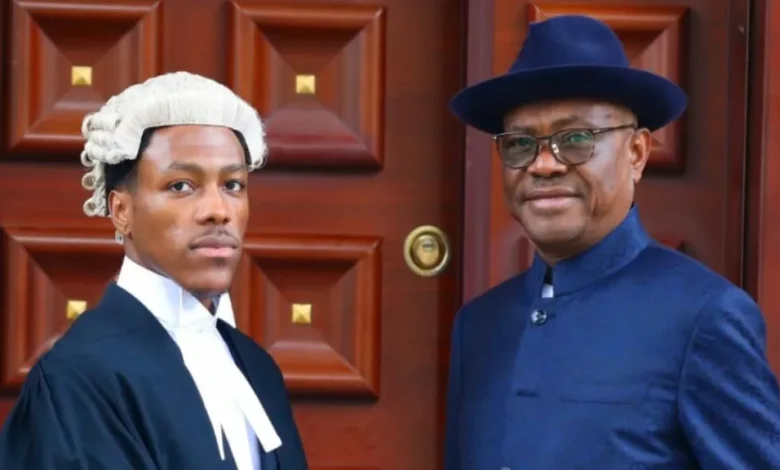
Jordan Ezenwo Nyesom-Wike, son of Federal Capital Territory (FCT) Minister Nyesom Wike, has denied receiving $2.1 million from businessmen over a disputed Abuja land transaction, telling an FCT High Court that the signature attributed to him on the agreement was forged.
Jordan made the denial on Wednesday, September 30, 2026, while being cross-examined before Justice Sylvanus Oriji at the High Court of the Federal Capital Territory in Maitama, Abuja.
The case, marked CV/008/2026, was instituted by businessman Safwan Garba GY and his company, GY Global Oil and Gas Nigeria Limited, who are seeking to recover the $2.1 million they allege was paid in connection with a proposed property development venture.
The claimants told the court that they first met Jordan in London in 2023 before developing a business relationship. They alleged that he later introduced a real estate investment opportunity involving land in the Guzape and Katampe districts of Abuja.
According to their statement of claim, the proposed joint venture involved Jordan contributing 1.7 hectares of land in Guzape Extension and another 1.5 hectares in Katampe New Extension, while Garba was expected to provide $4.2 million to finance the construction of residential properties.
The proposed arrangement reportedly provided for the proceeds from the sale of the completed properties to be shared, with Garba receiving 60 per cent and Jordan taking 40 per cent.
The claimants alleged that the arrangement subsequently changed, with Jordan requesting an initial payment of $2.1 million in cash and United States dollars.
They further alleged that the amount represented facilitation fees, with $2 million purportedly intended for the FCT minister and the remaining $100,000 for Jordan. These claims have not been established in court, and Nyesom Wike is not the defendant in the suit.
The claimants maintained that the money was handed over at a residence in Gwarimpa, Abuja, on September 26, 2025, in the presence of individuals they identified as Adamu Sani, Aliyu Sarki and Sai Wani. They alleged that Jordan was accompanied by a man identified as Onor Sandy, who purportedly witnessed the transaction.
They also claimed that an acknowledgement document bearing Jordan’s signature, alongside his identification details, was provided as evidence of the payment.
However, Garba and his company alleged that the promised land arrangement was not fulfilled. They said they later discovered that another company was preparing to develop the properties and subsequently sought a refund after efforts to resolve the disagreement failed.
The claimants are asking the court to order repayment of the $2.1 million, alongside N100 million in damages and other reliefs.
Jordan has rejected the account, insisting that he neither received the money nor entered into the alleged business arrangement with the claimants.
During cross-examination, he disputed the signature on the agreement and denied knowing Onor Sandy, whose name appeared as a purported witness to the transaction.
“I did not receive any money from anybody. I did not sign any document for land deal,” he told the court, according to Punch.
He also maintained that he had no business dealings with Garba or his company and described the signature attributed to him as forged. When asked whether he had reported the alleged forgery to the police, he answered in the negative.
A major issue during the proceedings was Jordan’s whereabouts on the date the claimants said the money was handed over.
He told the court that he was outside Nigeria on September 26, 2025, and had travelled using his American passport. Following an application by the claimants’ counsel, the judge ordered him to produce the document.
Jordan presented the passport during the September 30 proceedings. The court admitted it in evidence and allowed a photocopy to remain on the court record, while the original was returned to him on the condition that it would be produced again whenever required.
The passport evidence forms part of the ongoing dispute over the defendant’s account of his whereabouts on the date of the alleged payment. Its admission does not, by itself, determine whether the transaction took place or whether the claimants’ allegations are accurate.
The court also granted an earlier request by the claimants’ lawyer for Jordan to write his full name and signature five times each on plain sheets of paper. The exercise forms part of the evidence being presented in the dispute over the authenticity of the document.
During the latest hearing, the claimants’ counsel also referred Jordan to a transcript of a voice note dated October 17, 2025, which had previously been admitted as an exhibit. Asked whether the transcript contained a discussion relating to money, Jordan acknowledged that it did, but maintained his denial of receiving the disputed funds.
The proceedings have therefore centred on competing accounts of the proposed business arrangement, the alleged cash payment, the disputed contract and the evidence presented by both sides.
Justice Oriji adjourned the matter until December 1, 2026, to allow the defence additional time to subpoena witnesses. Further proceedings are expected to examine the evidence and the parties’ competing positions.
The case remains unresolved, and the court has not made a finding that Jordan received the $2.1 million, forged documents or defrauded the claimants. Equally, his allegation that the signature was forged has yet to be established through a judicial determination.
The outcome will depend on the evidence presented during the trial and the court’s assessment of the disputed documents and testimony.