


By TheDailyNewsHub News Desk | October 5, 2026
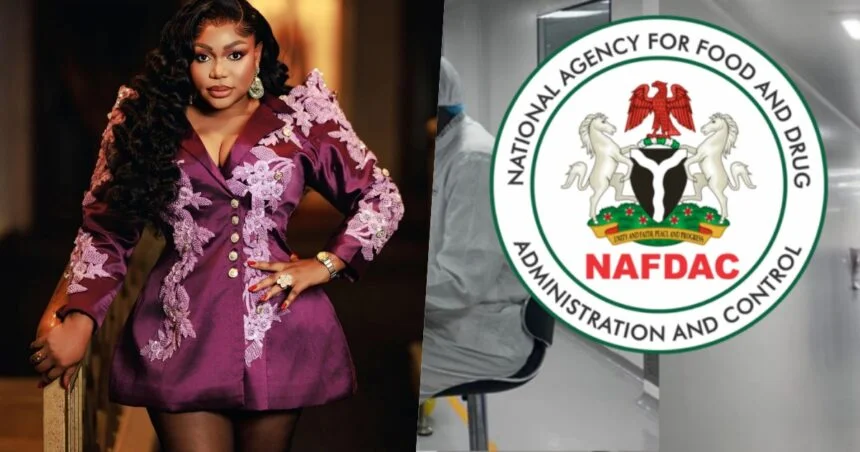
Nollywood actress and filmmaker Ruth Kadiri has called on the National Agency for Food and Drug Administration and Control (NAFDAC) to intensify efforts against suspected counterfeit and potentially harmful products in Nigeria, after recounting an unusual experience involving garlic she purchased.
Kadiri raised the concern in a video message shared online on Sunday, October 4, 2026, in which she spoke about the safety of food, drinks, medicines, cosmetics and household products available to Nigerian consumers. Her remarks have since drawn attention to the wider problem of counterfeit and substandard products and the responsibility of regulators and consumers in identifying them.
The actress said she bought garlic, blended it and briefly left the area before returning to find that its colour had changed.
“I bought garlic, blended it, went upstairs, and came back to find my garlic had turned green,” Kadiri said in the video, according to reports of her remarks.
She presented the experience as part of a broader concern about products that consumers purchase believing they are safe. She also said she had become cautious about buying already packaged drinks for her children because of fears about the quality of some products.
Kadiri urged Nigerians to pay attention to product information, particularly expiry dates and NAFDAC registration numbers, while calling on people to report suspected counterfeit products in their communities.
“NAFDAC, please pay attention to the lives of Nigerians,” she said, warning that people may suffer health consequences from unsafe products without immediately knowing the source of the problem.
However, Kadiri’s observation about the garlic should not be treated as proof that the product was counterfeit, contaminated or dangerous. No laboratory test or regulatory finding has been reported linking the colour change to adulteration or confirming that the garlic was unsafe. Food can undergo colour changes for a number of reasons, and establishing whether a product is contaminated or otherwise unsafe requires appropriate scientific testing.
NAFDAC is responsible for regulating food, drugs, cosmetics, medical devices, chemicals and other regulated products in Nigeria. The agency operates product-verification systems through which consumers and other stakeholders can check registration information. Its regulatory framework also provides for investigation of complaints involving suspected substandard and falsified products.
The agency has previously issued public alerts concerning counterfeit and substandard products in Nigeria. Its alerts have covered medicines, food products, cosmetics and other regulated goods, demonstrating that counterfeit-product concerns are not limited to a single category.
Consumers are able to verify registered products through NAFDAC’s online systems, while the agency also provides channels for reporting suspected substandard or falsified medical products. Its Greenbook reporting platform asks complainants to provide information about the product, where it was purchased and evidence such as photographs, packaging or samples to assist investigations.
Kadiri’s warning comes only weeks after TheDailyNewsHub reported on a separate consumer-safety concern in Lagos, where the Lagos State Consumer Protection Agency warned residents about increasingly sophisticated methods of adulterating palm oil. Authorities stressed in that case that visual inspection alone could not establish whether palm oil had been adulterated and recommended scientific testing.
The issue of counterfeit products is also receiving attention from lawmakers. In July, the Senate advanced a bill seeking to replace the existing legal framework covering counterfeit medical products, fake drugs and unwholesome processed foods. The proposed legislation includes stronger enforcement powers and penalties of up to 15 years’ imprisonment for serious offences if the bill eventually becomes law.
The proposed legislation is not yet law, and its provisions should therefore not be presented as current penalties applicable to all counterfeit-product offences.
For consumers, the episode underscores the importance of obtaining regulated products from reliable sources and checking relevant registration and expiry information. Where a product appears suspicious, consumers should preserve the packaging and other available evidence and report the matter to the appropriate regulatory authorities rather than relying solely on appearance to determine whether it is counterfeit.
Kadiri’s comments have consequently renewed public attention on an issue that extends beyond individual purchases: ensuring that products entering Nigerian homes and pharmacies meet the safety and quality standards required by law.