


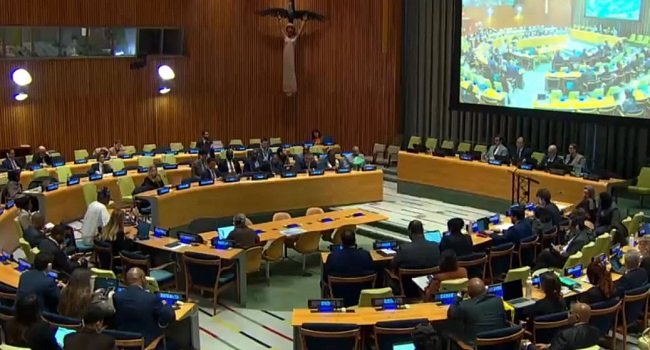
President Bola Ahmed Tinubu has called on the United Nations Security Council to provide stronger leadership in enforcing international rules against the proliferation of weapons of mass destruction and to support efforts toward the complete elimination of nuclear weapons.
Tinubu’s position was conveyed by Nigeria’s Permanent Representative to the United Nations, Ambassador Jimoh Ibrahim, at a high-level UN General Assembly meeting in New York on Tuesday, September 29, marking the International Day for the Total Elimination of Nuclear Weapons. The United Nations scheduled the meeting specifically to raise awareness of the dangers posed by nuclear weapons and promote international efforts toward a nuclear-weapons-free world.
According to Channels Television, Ibrahim said the President asked him to communicate Nigeria’s position that the Security Council should play a more active role in upholding the principles of the UN Charter, including through sanctions against the proliferation of weapons of mass destruction.
Ibrahim also conveyed Tinubu’s position that Nigeria’s national security does not depend on possessing nuclear weapons. He noted that Nigeria is a non-nuclear-weapon state and does not possess nuclear weapons.
The Nigerian envoy said the country does not support the production or proliferation of nuclear weapons and stressed the importance of international compliance with existing disarmament and non-proliferation commitments.
He also highlighted the UN Charter’s prohibition on the threat or use of force against the territorial integrity or political independence of states, while linking adherence to international law with efforts to reduce the risks associated with weapons of mass destruction.
The timing of Nigeria’s appeal coincided with a UN meeting focused specifically on nuclear disarmament. The UN says more than 12,000 nuclear warheads remain in global arsenals, while between 2,100 and 2,200 are estimated to be maintained at high operational alert. The President of the 81st General Assembly, Khalilur Rahman, warned at Tuesday’s meeting that the global nuclear stockpile is expected to grow again as new warheads enter arsenals faster than older ones are dismantled.
Rahman also pointed to the expiration of the New START treaty between the United States and Russia on February 5, 2026, leaving the two countries without binding limits on their strategic nuclear arsenals for the first time since 1972. He described the combination of weakened arms-control arrangements, geopolitical tensions and nuclear modernisation as an increasingly dangerous environment.
Nigeria has consistently supported nuclear disarmament while maintaining its position that nuclear technology can have peaceful applications. The country is a non-nuclear-weapon state under the Nuclear Non-Proliferation Treaty and is also part of the African nuclear-weapon-free zone established by the Treaty of Pelindaba.
Nigeria’s latest intervention also reflects the country’s longstanding position on nuclear disarmament. In 2020, former President Muhammadu Buhari similarly urged nuclear-armed states to fulfil their obligations under Article VI of the Nuclear Non-Proliferation Treaty, which concerns negotiations toward nuclear disarmament.
The distinction is important because Article VI of the NPT, rather than “Article 6 of the UN Charter,” contains the treaty’s disarmament obligation. The UN Charter provision concerning the prohibition of the threat or use of force is Article 2(4). This distinction avoids conflating two separate international legal instruments.
At Tuesday’s UN meeting, Nigeria also expressed support for international efforts to prevent nuclear testing and for greater cooperation among states to eliminate nuclear weapons. The meeting was part of the 81st UN General Assembly’s programme and took place at a time of renewed concern over nuclear risks and the weakening of established arms-control arrangements.
Nigeria’s intervention comes against a wider backdrop of heightened international tensions over nuclear programmes and weapons proliferation. The UN General Assembly’s nuclear-disarmament meeting was intended to reinforce the international commitment to reducing nuclear risks and ultimately eliminating nuclear weapons.
By TheDailyNewsHub Reporter